
You know what? A Gentleman is not a Gentleman until his wrist is equipped with a premium quality watch. Amongst the varieties of these premium watches, the mechanical watch is still the highlighted invention of its time, maintaining a great history. The first mechanical watch (spring-powered) appeared in the 16th century, and the credit for this goes to Peter Henlein. It operates with the joint effort of tiny parts, each ensuring the accuracy of time measurement.
In today’s guide, we will examine the relevant parts of mechanical watch movement. How does each part serve its functionality specifically? How do they ensure accuracy, longevity, and maintain a solid importance in today’s market? Let’s start!

The Mechanical Watch Movement is the process that enables the watch to fulfill its core functionality, which is the measurement of time. It involves the contribution of various parts that store energy, transfer the power, and display the time accordingly. These parts generally include gears, springs, levers, and many others.
In Technical terms, the mechanical watch movement is also called “Calibre”. Similarly, it is also considered the main engine or heart to power the watch accordingly. Such a watch movement works opposite to the quartz watches that function based on battery power. Instead, mechanical watch movement works based on energy storage and release.
A mechanical watch offers two movements, one is automatic and the other is manual movement.
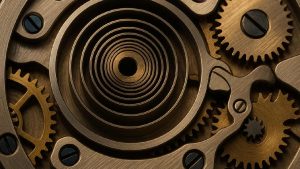
Watch mainspring is a watch movement part that stores and delivers the required energy to the watch. This coiled strip is located inside the barrel and made up of carbon steel and special alloys. In manual watches, the mainspring winds through the crown as it turns. Similarly, in automatic watches, the mainspring winds through the rotor.
The barrel in a mechanical watch movement is a round drum that holds the mainspring inside it. It controls the amount of stored energy released towards the gear train, maintaining the accuracy and effectiveness of watch operations. Additionally, some watches may be equipped with double or more barrels to enhance the energy reserves.
The gear train contains a series of different gears that transfer the energy from the mainspring/barrel to the escapement. It includes the following wheels,

Escapement, in other words, is considered the heart of mechanical watches. It efficiently controls the amount of energy transferred by the gear train to maintain an appropriate flow. It enhances the accuracy of time and balances the smooth flow of energy or power.
The balance wheel in a watch movement maintains the energy or power transferred by the escapement. It functions by oscillating back and forth to control the time. Similarly, it is measured in Vibrations Per Hour (VPH) and keeps the time operating under a maintained frequency. The notable common rates here include 21,600 to 28,800 VPH.
The hairspring is a coil spring attached to the balance wheel. It controls the oscillation speed and assists the balance wheel in returning to its neutral form. This mechanism keeps the watch timing and other functionalities in a controlled manner. The hairspring is made up of steel or alloy material for its longevity.
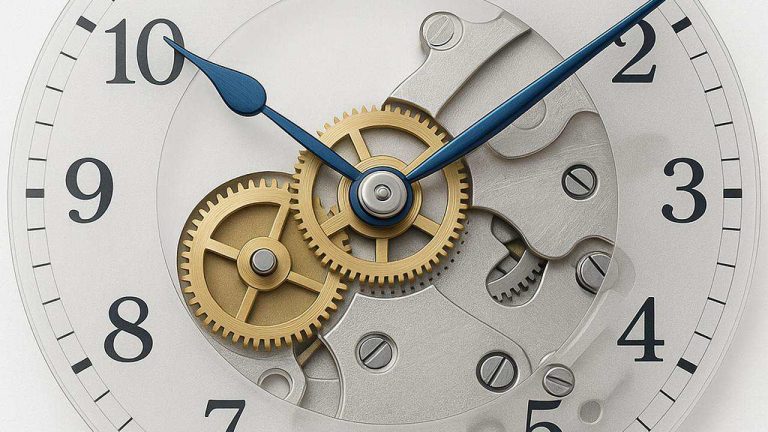
The dial train, and hands are those watch movement parts that function to control the entire operation of a mechanical watch. A dial train transfers power from the gear train to the hour, minute, and second hands. Other than that, the functions related to date and moon phase are also linked to the dial train.
Rotor serves its functionality only in automatic mechanical watches. It is a component or part that swings when the wearer’s wrist moves. This movement enables the rotor to provide power to the mainspring, and the watch starts functioning accordingly. Similarly, a rotor can move in any direction as the wrist moves.
Bridges and plates offer a structural order where all the parts of a mechanical watch are mounted accordingly. These are made up of brass or rhodium to ensure reliability and durability. Bridges and plates are usually decorated with luxurious finishing in premium quality mechanical watches.
Jewels are the parts used as bearings to eliminate the friction between moving parts. First, it ensures a smooth mechanism of parts movements; second, it enhances the lifespan of watch components. Hole jewels, cap jewels, pallet jewels, and impulse jewels are the notable types of jewels offering 15–17 jewels in a basic watch.
A crown is the outside part of a mechanical watch, similar to a knob. It powers up the mainspring and assists in setting the time plus date. Similarly, the stem is a tiny component that connects the crown to the wind movement and functionality of the time/date settings. Crowns are available in different variants, like water-resistant and push-pull crowns.

As a whole, the core functionality of mechanical watch movement can be understood through the following bullet points.
The mechanical watch is not just a watch; it is a result of remarkable engineering. Every part in the mechanical watch movement makes a significant contribution. Starting from a mainspring to a small jewel, it tells a whole story of its unique invention. Understanding the parts can help to diagnose problems, conduct new research, and is helpful for watch enthusiasts to learn the engineering principles.
At Sofly, the watch enthusiasts can get all the watch repair tools, watch parts, and other related accessories. Moreover, Sofly is also offering the ETA watch movement parts. Do check them out and become a part of the tremendous watch enthusiasts.
A: The mainspring and barrel are the most important parts of a mechanical watch movement. It is the place where everything begins. Other parts are also equally important, like the gear train, escapement, balance wheel, and hairspring.
A: Well, as per the recommendation, 17 jewels meet the requirements of a basic watch functionality. Apart from that, it can be more than that based on the requirement.
A: Yes, but not always, because a higher beat rate in general works well against the shocks. The type of material and its lubrications matter a lot.