
Even in today’s digital age, mechanical watches remain treasured for their artistry, craftsmanship, and analog soul. While quartz watches rely on battery-powered precision, mechanical timepieces run purely on mechanical energy — using gears, springs, and friction-regulated oscillation.
For many collectors and enthusiasts, the value of a mechanical movement lies not in absolute accuracy, but in its emotional connection to time itself. It’s the satisfying ritual of winding, the steady sweep of the second hand, and the appreciation of intricate engineering under the dial.
Whether you’re restoring a vintage timepiece, assembling your own build, or simply curious about traditional horology, this guide offers a comprehensive dive into everything mechanical watch movements can offer.

A mechanical watch movement is the heart of a traditional watch — a self-contained machine that operates without electricity. Its engine is a mainspring, a tightly coiled strip of metal that stores energy when wound.
This energy is gradually released to move a complex series of gears and levers. The result is the elegant, continuous motion of the second hand — often described as a “sweep” — that distinguishes mechanical watches from their ticking quartz counterparts.
Mechanical movements are valued not just for telling time, but for telling a story — one of precision, heritage, and mechanical beauty.
The mechanical movement’s operation begins with winding the crown, which tightens the mainspring. As it unwinds, the energy travels through the gear train, delivering power to the escapement — a system that meters the energy in precise intervals.
The balance wheel, working like a pendulum, oscillates back and forth, governing the watch’s tempo. Each vibration advances the gear train incrementally, moving the hands at a regulated pace.
This process requires no battery — just expert engineering, gravity, and time.

Understanding what makes a mechanical movement tick starts with its parts:

Each part must be precisely manufactured and harmonized to ensure accuracy, durability, and longevity.
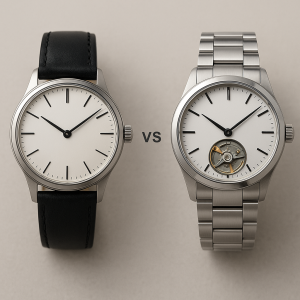
There are two main types of mechanical movements:
These require you to wind the crown daily or every few days, depending on the power reserve. Manual movements are known for being slimmer and offer a strong emotional connection to the mechanism.
They are ideal for purists, vintage lovers, and those who appreciate a watch’s internal choreography.
These movements contain a rotor that winds the mainspring using natural wrist motion. They’re convenient for everyday wearers and require less hands-on upkeep — just wearing the watch is often enough to keep it running.
Modern automatic movements often also support manual winding as a backup feature.
Feature | Manual Watch Movement | Automatic Watch Movement |
Winding Method | Daily by crown | Wrist-powered rotor (plus manual wind) |
Design Profile | Slim and elegant | Thicker due to rotor assembly |
User Interaction | Tactile, traditional | Convenient, set-and-forget |
Popular Use Cases | Dress watches, vintage builds | Sports watches, daily wear |
Maintenance Cycle | Every 5–10 years | Every 5–10 years |
Looking to upgrade or build your own watch? Browse our range of manual and automatic watch movements — trusted by watchmakers, modders, and collectors.
Winding your manual watch movement correctly is essential for performance and protection.

Whether you’re a microbrand assembling a small batch or a hobbyist replacing an aging movement, these are some of the most trusted models available:
Model | Origin | Key Features |
Sellita SW200 | Switzerland | ETA 2824 alternative; 38h power reserve |
Seiko 6R15 | Japan | Mid-tier, reliable, ~50h power reserve |
Miyota 8215 | Japan | Affordable and commonly used by microbrands |
ETA 6497 | Switzerland | Manual-wind, large format for pocket/pilot watches |
Rolex 3135 | Switzerland | Luxury grade, high precision, long-term durability |
Sofly Parts offers professional-grade mechanical watch movements for sale — all tested for accuracy and durability.

Proper care can keep your movement ticking accurately for decades:
Bonus tip: For automatics you rarely wear, consider a watch winder to keep them running and prevent lubricant buildup.
A mechanical watch is more than a tool — it’s a work of kinetic art. Its steady rhythm, elegant mechanics, and tactile maintenance connect us with time in a deeply human way.
Whether you’re a seasoned collector or just getting started with your first build, choosing the right manual or automatic watch movement is a rewarding experience.
Need help choosing?
Explore Sofly Parts for premium-grade mechanical movements trusted by builders, restorers, and professionals worldwide.