
Beginner’s Guide to Watch Regulation and Accuracy Adjustment

Introduction

Modern watchmaking has come a long way in improving time accuracy. Today’s models are highly reliable, yet even the best watches may gain (+) or lose (–) a few seconds over time. This is especially true for mechanical watches, which require occasional fine-tuning. Their tiny components—mainspring, gear train, escapement, balance wheel, and hairspring—are all sensitive to external factors.

If your watch starts running too fast or too slow, it’s time to consider regulation and accuracy adjustment.
In this beginner’s guide, we’ll walk through the basics: what regulation means, why watches lose or gain time, the tools you’ll need, how to measure accuracy, and a step-by-step process for adjusting your watch.
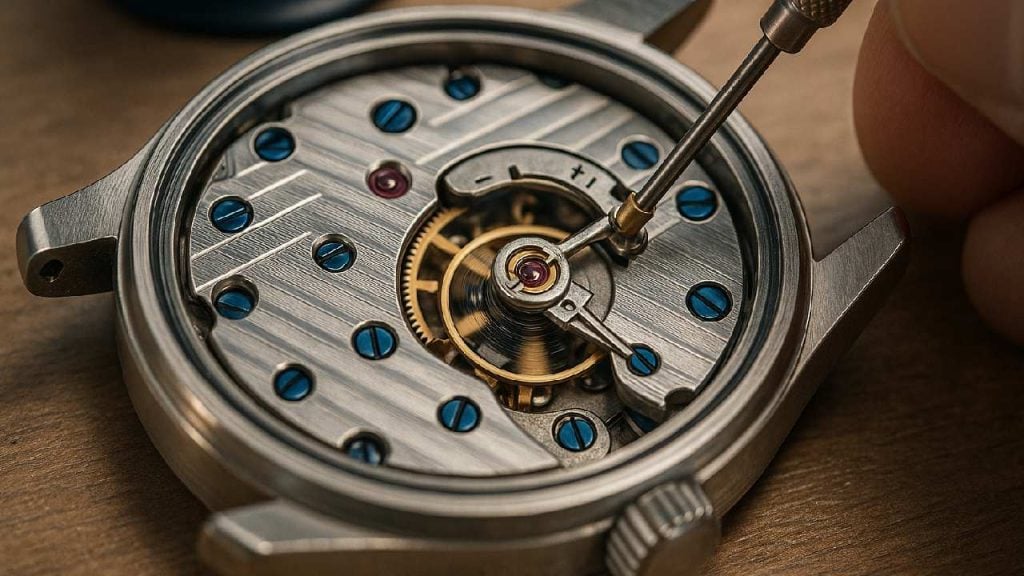
Time Accuracy of Watch

What is Watch Regulation?

NOTE: The watch regulation does not lie in the category of watch servicing or watch repairing.

Watch regulation is the process of adjusting or correcting the time on the watch as per the standard time. It ensures the time accuracy and watch operations are smooth as required. The mechanical components in watches, such as the movement, springs, and gears, can disrupt the time due to several reasons, including temperature, gravity, and high wrist movement.

To perform watch regulation and accuracy adjustment, one needs to play with tiny watch components. It includes adjusting the oscillation speed of the balance wheel and the regulator index in accordance with the correct time. Watch-compatible tools are required to regulate the watch time. This results in fixing and adjusting the watch run at a stable speed.
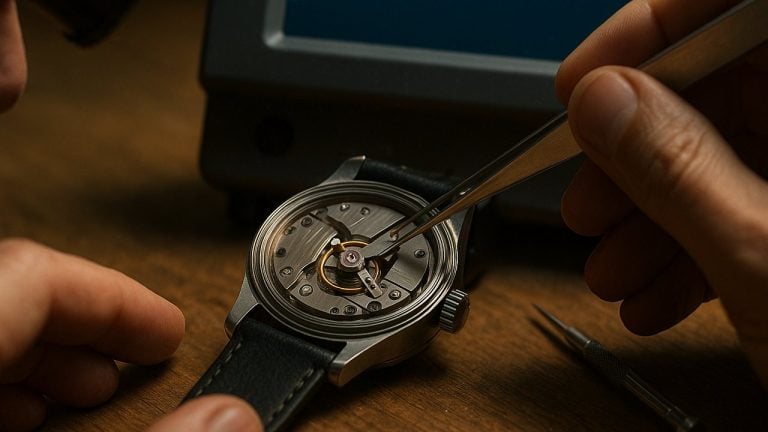
Why Do Watches Lose or Gain Time?

  • Positional Conflict: The position of a mechanical watch can impact its time accuracy, such as when it is face up or face down. It calculates the different gravitational impacts on the balance wheel and hairspring.
  • Temperature Impact: Change in temperature ranges tends to have an impact on the expansion and contraction of watch parts (metal). It may directly conflict with the regular pace of the balance wheel and hair spring, disturbing the time.
  • Wear & Tear: With the passage of time, the tiny parts and components of the watch become aged and start taking the impact of dryness, dirt, and dust. It causes the parts to reduce their performance efficiency, resulting in inaccurate timekeeping.
  • Magnetism Effect: When watches are exposed to magnetic fields, such as phones, speakers, laptops, and other electronic devices. This causes a conflict with hairspring coils, resulting in a fast running of the watch and leading to inaccurate time.
  • User Habits: A user’s habit of wearing the watch also has an impact on its timekeeping accuracy. Yes, it matters whether the watch is worn regularly or left idle for a long time. Both situations have a notable effect on performance and time accuracy.
Watch Regulation

Why Time Accuracy Matters?

  • Time accuracy has a positive impact on an individual’s daily schedule or routine, ensuring punctuality.
  • Time accuracy of a watch in professional or practical usage is crucial, such as in military, medical, diving, aviation, and other applications.
  • Believe it or not, an accurate time on a watch creates a sense of satisfaction in the mind that helps build confidence and trust.
  • The time accuracy of a watch is also linked to its market or resale value. Watch collectors and enthusiasts tend to value accurate watches more than others.
  • The time accuracy of a watch ensures the durability and longevity of its parts and components, as it places less strain on the watch movement.

How to Measure a Watch’s Accuracy

  • Compare the time on your watch with a time on a reliable source like an atomic clock, GPS, or by using time-telling applications.
  • Wear the watch and test its timekeeping in multiple positions, usually up/down, and match the showing time with the reference source.
  • Specifically for mechanical watches, fully wind the watch and note whether the required power is distributed to the other parts or not.
  • After an interval of 24 hours, again compare the current time on your watch with the reference source to see the alignment of time accuracy.
  • Once done, try to repeat this whole process of measurement for about 3 to 5 days. It will double-check whether your watch time is accurate or needs regulation.

Watch Accuracy Standards

  • Quartz Watches: + or – 15 seconds a month.
  • Mechanical Watches: + or – 20 to 30 seconds per day.
  • High-End Mechanical Watches: + or – 4 to 6 seconds per day.
  • Luxury Category Watches: + or – 2 seconds per day.
Watch Regulation Tools

Watch Regulation and Accuracy Adjustment

Before attempting the watch regulation and accuracy adjustment, make sure to have the following compatible tools at your table.
Tools Needed for Watch Regulation

Step-by-Step Watch Regulation Process

1: Visual Inspection

  • Carefully inspect the watch case, watch glass, watch back, watch straps, and other components before opening the watch. If there is a sign of anything unusual, first correct it, then perform the regulation.

2: Measure Accuracy

  • Compare the current time of your watch with a reliable reference source. It will assist in evaluating whether your watch is gaining or losing seconds. Then it will become easy to make regulations accordingly.

3: Open Watch Case

  • Pick the case opener tool and open the watch case from the back. Make sure to avoid dust, and also make sure about the waterproof seals if your watch is water-resistant. Keep the pressure of your hands gentle to avoid scratches.
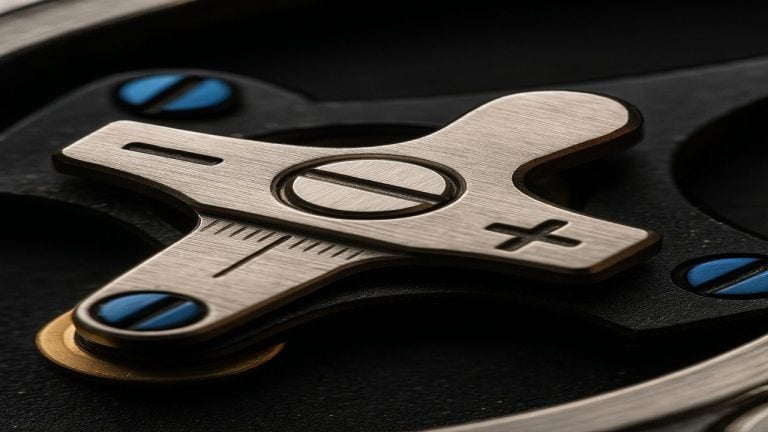
Regulator of Watch

4: Locate Regulator

  • Once the watch case is opened, the movement is visible in front of you. Look for the regulator inside the movement (use the magnifying glass if needed). The locator usually has “+ & -” or “F & S” marks over it; this hint will help to locate the regulator easily.

5: Make Adjustments

  • Pick the small screwdriver or tweezers and move the regulator as per the requirement. If your watch is running slower, move toward the + or F direction. Similarly, if your watch is running faster, move toward the – or S direction. Don’t move so fast in any direction.

6: Test the Final Accuracy

  • Once the regulator is moved in the required direction, it’s time to compare the watch time with the reference unit. If it is showing everything matched, then you are done. If it needs further adjustment, repeat the process and regulate the time accordingly.

Watch Regulation Vs. Accuracy Adjustment

Watch Regulation

It involves normal time-tuning of a watch by adjusting the balance wheel and hairspring to regulate the speed. Watch regulation helps to change the misaligned seconds of a watch using a time machine, along with the regulator index, micro-screws, or balance weights.

Accuracy Adjustment

It is something broader in its sense, as it includes the time regulation at multiple positions and multiple power levels. Accuracy adjustment features make corrections to balance the wheel, compensate for beat error, and account for temperature variations.

Result

Both methods ultimately result in delivering accurate watch time, but with different mechanisms at the backend. Watch regulation is linked to simple daily adjustments and can be performed by beginners as well. At the same time, the accuracy adjustment requires a professional skill set to play with watch parts and components because it is a complete optimization of the watch.
Watch Accuracy Adjustment

How Often Should a Watch Be Regulated?

  • New Watches: Don’t need regulation for the first few years.
  • Daily Wearing: When the watch starts gaining or losing more than 20 seconds per day, it needs a regulation attempt.
  • Mechanical Watches: These watches should be regulated after 2 to 3 years to ensure accurate timekeeping.
  • After Shocks/Magnetism: A watch may require a regulation attempt if dropped, magnetized, or has face pressure or severe vibrations.
  • User Choice: If you are among those who just want to have perfect timekeeping on a watch, you can attempt to regulate it when you want.

Common Mistakes to Avoid

  • Never attempt to adjust regulation or accuracy without the relevant knowledge.
  • Avoid over-adjusting or movement of the regulator.
  • Avoid using incompatible tools to perform watch regulation.
  • Be cautious when touching the hairspring, as it can be permanently damaged.
  • Don’t forget to check for beat error; only the adjustment rate is not sufficient.

Conclusion

At some point, every mechanical watch needs regulation. While minor adjustments can be done by careful beginners, full accuracy adjustments are best left to professionals. By understanding the causes of inaccuracy and following a structured process, you can keep your watch precise and reliable.

For DIY watch enthusiasts and professionals alike, Soflypart offers premium tools, polishing kits, and watch movement parts to support your journey. Visit our product page to explore the full range.