
How does a watch mainspring work? It stores energy through winding and powers the watch by releasing that energy gradually. This guide explains it all clearly and concisely.
A watch mainspring is the tightly coiled strip of metal at the heart of every mechanical watch. It’s the component responsible for storing and releasing the energy that powers the entire movement. Typically housed within a barrel, the mainspring is wound manually via the crown or automatically through wrist movement, gradually uncoiling to deliver consistent torque to the gear train.

Historically, the invention of the mainspring was a breakthrough in horology. It allowed clocks and timekeeping devices to become portable, transitioning from massive tower installations to pocket watches and eventually wristwatches. The mainspring made personal timekeeping possible, marking the beginning of modern horological innovation.
Whether you’re a watch enthusiast, a collector, or a DIY repair hobbyist, understanding how a mainspring works is crucial. It helps you better appreciate the mechanical engineering behind your timepiece, as well as recognize early signs of mechanical issues.
From maintenance to troubleshooting performance fluctuations, knowledge of the mainspring’s role and behavior can save time, money, and frustration. It also allows you to make informed decisions when purchasing, servicing, or restoring mechanical watches, especially vintage models, where mainspring condition is critical.
At its core, a watch mainspring is a long, thin ribbon of high-tensile metal, typically made from hardened steel or modern alloys such as Nivaflex, known for their excellent elasticity and corrosion resistance. This strip is coiled tightly into a circular shape and stored inside a barrel, a round housing that protects the spring and regulates its motion.

One end of the mainspring is anchored to the barrel wall, while the other is attached to the arbor, a central spindle that rotates during winding. As you wind the crown (in manual watches) or wear the watch (in automatics), the arbor turns, coiling the mainspring tighter. This builds potential energy that will later drive the entire gear train.

The mainspring acts much like a twisted rubber band. When wound, it builds tension as the metal resists being coiled tighter. This stored potential energy is then slowly released as the mainspring uncoils.
This gradual unwinding delivers torque, a rotational force, to the watch’s gear train. The barrel turns incrementally, powering the wheels and pinions that move the hands on the dial. A well-made mainspring is engineered to release energy as evenly as possible, ensuring consistent timekeeping.

The key to accurate timekeeping lies in controlled energy release. Without it, a watch would tick too fast or too slow, depending on the level of tension in the mainspring.
To regulate the power flow, mechanical watches use an escapement mechanism, typically a Swiss lever escapement. This mechanism “escapes” a tiny bit of energy at regular intervals, transmitted through the balance wheel and hairspring, which oscillate back and forth at a constant rate.
This intricate balance of force, resistance, and timing is what makes the mainspring not just a power source but a foundational part of the watch’s entire timekeeping architecture.
The evolution of watch mainsprings reflects broader advancements in watchmaking materials and technology. Traditional mainsprings, commonly found in vintage watches, were made from high-carbon steel. While strong, they were prone to rust and metal fatigue, often resulting in breakage after years of use.

Modern watchmakers have largely shifted to advanced alloys like Nivaflex and Elinvar, which offer improved resistance to corrosion, magnetism, and temperature fluctuations. These materials provide greater longevity, consistent torque output, and enhanced safety — modern mainsprings rarely break catastrophically as older steel ones did.
The evolution also includes innovations like the slipping bridle, used in automatic watches to prevent overwinding by allowing the mainspring to slip once it’s fully wound. This feature improves both safety and durability.
While all mechanical mainsprings perform the same basic function — storing and releasing energy — their winding mechanisms differ depending on the type of watch.


This difference impacts not only functionality but also case design, movement architecture, and user experience. Automatic movements generally have larger barrels to support longer power reserves and must include slipping mechanisms to prevent mainspring damage.
A mainspring’s performance and lifespan are directly influenced by the quality of the material used. Traditional carbon steel springs can become brittle, lose elasticity, or even snap after prolonged use, especially when exposed to moisture or corrosion.
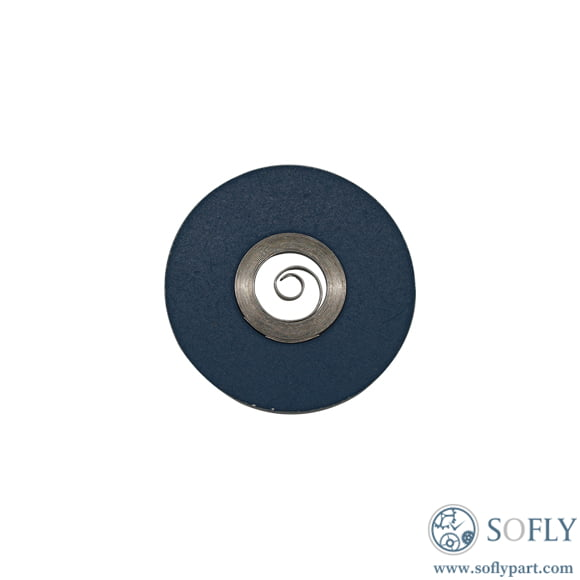
Modern alloys like Nivaflex, Hivac, or Dynavar are engineered to resist metal fatigue, providing stable torque over a longer period. These materials maintain their structural integrity through thousands of winding and unwinding cycles. However, even advanced mainsprings will eventually degrade, particularly in watches that are never serviced.
Signs of fatigue include reduced power reserve, erratic timekeeping, or uneven force delivery to the gear train.
That’s why regular inspection and timely replacement of your watch mainspring is essential to long-term performance. At Soflypart, you can find a wide selection of reliable watch mainspring parts and tools, trusted by professionals and enthusiasts alike.
Lubrication plays a critical role in the smooth performance of a mainspring. Without proper oiling, the spring can stick to the inner barrel wall, causing inconsistent torque output—a phenomenon known as “stiction.”

Watchmakers apply specialized lubricants inside the mainspring barrel to reduce friction and ensure even unwinding. However, lubricants degrade over time, becoming gummy or drying out completely, which diminishes performance.
Recommended maintenance involves full cleaning and re-oiling every 3 to 5 years, depending on the watch’s use, environment, and age. Regular maintenance prevents premature wear and keeps the mainspring functioning at peak efficiency.
Several external factors can impact the behavior and longevity of a mainspring:
To counter these effects, many contemporary watches feature sealed cases, anti-magnetic shielding, or are made from inherently resistant materials. For example, ISO-certified anti-magnetic watches are tested against field strengths up to 4,800 A/m or higher.
Over time, even the most well-made mainspring can experience issues. Common symptoms of mainspring failure include:
Watchmakers use a variety of diagnostic techniques, including checking amplitude and power reserve measurements on a timegrapher, to determine whether the mainspring is no longer functioning properly.
Replacing a mainspring is a delicate task that requires precision tools and specialized skill. A trained watchmaker typically follows this process:
Due to the risk of damaging the movement, mainspring replacement is best performed by professionals or experienced hobbyists with proper training and watch repair tools. Attempting DIY repair without the necessary expertise can lead to further complications or permanent damage.
To extend the life of a watch mainspring and maintain optimal performance over time, consider the following best practices:
By following these preventive measures, you reduce wear on the mainspring and ensure smoother, more reliable operation across the watch’s lifespan.
The watch mainspring may be hidden deep within the movement, but its role is central to how a mechanical watch works. Acting as both the power source and a driver of consistency, the mainspring is a marvel of compact mechanical engineering that bridges tradition with precision.
Understanding how it functions, the types available, and how to care for it not only deepens your appreciation for fine watchmaking but also empowers you to make better decisions, whether you’re buying, maintaining, or restoring a timepiece.
With proper care and attention, a well-made mainspring can perform its quiet but critical task for decades, ticking away reliably, one oscillation at a time.
Looking for quality watch parts or mainspring repair tools? Visit SoflyPart — your trusted source for professional-grade watch repair supplies and tools, trusted by both independent watchmakers and enthusiasts worldwide.
Breakage is usually caused by metal fatigue, rust, or improper winding. Older steel mainsprings are more prone to snapping due to age and corrosion.
Replace it if your watch stops suddenly, loses power quickly, or shows erratic timekeeping. A full service is also a good time for replacement.
Modern mainsprings can last decades with proper care. Regular servicing every 3–5 years helps maintain performance and prevent premature failure.
Automatic mainsprings are wound by wrist motion; manual ones require hand winding. Automatics also include mechanisms to prevent overwinding.
Manual winding offers a tactile experience, while automatics are more convenient. Both types are reliable—your preference depends on usage and routine.