How to Effectively Remove Watch Band Pins - A Guide for Beginners

Introduction

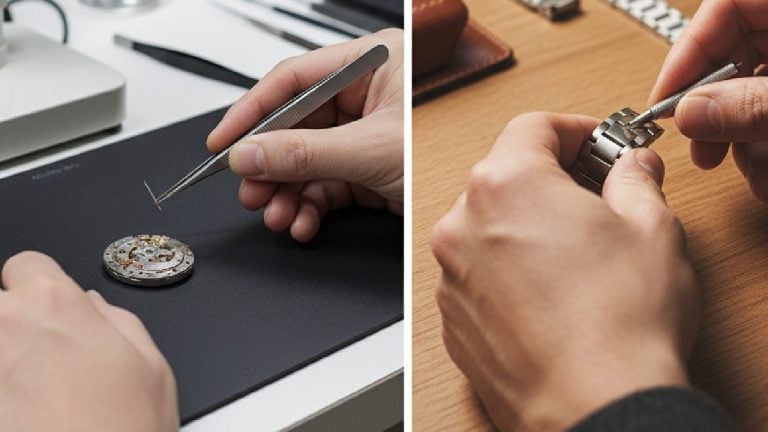
A watch, in actuality, is not just a timepiece to wear on the wrist. It requires regular maintenance, servicing, and occasional replacement of parts. Watch bands are one among these parts, components, or accessories. When repairing, replacing, or resizing watch bands, one must deal with watch band pins. The band pins are considered a bit tricky component to remove from the watch. However, with the help of proper knowledge and the necessary tools, one can effectively attempt to remove the watch band pins.

In this ongoing series of removing watch parts, today, we will discuss how to remove the watch band pins efficiently. What tools are required for this procedure? How can one adjust a metal watch band that has no pins? How to re-insert the watch band pins?

Watch Band Pins

Understanding Watch Band Pins

The term “watch band pins” refers to tiny, rod-shaped metal components used to attach the watch band, strap, or bracelet to the watch case. The other known names for watch band pins are spring bars and link pins.

The watch band pins ensure watch safety and the comfort of wearing the band around the wrist. The working mechanism of watch band pins is based on spring-loaded ends that can be compressed when inserted into the holes.

Core Features

  • Watch Band Pins ensure the safety of the watch straps and the watch itself.
  • Watch Band Pins are made from a durable material, mostly stainless steel.
  • Watch Band Pins are used in band material of every type, like leather, rubber, and metal.
  • Watch Band Pins are available in multiple sizes to accommodate various strap sizes.
  • Watch Band Pins are resistant to water, dust, and corrosion.
Types of Watch Band Pins

Types of Watch Band Pins

Spring Bars:

Spring bars are the most common type of watch band pins. It operates on a spring-loaded system, allowing compression when pressed. Spring bars are easily inserted and removed using the spring bar tool. This type is best suited for quick-release straps.

Friction Pins:

This type of watch band pin is also known as a pressure pin. Instead of a spring-loaded system, friction pins rely on tight fitting or friction with straps. The one end of the friction pins is made thinner than the other. These solid pins are mostly used in metal bands.

Split Pins:

The split pins, in general, are empty metal tubes having a bend in the middle and are mostly used in stainless steel watch bands. One end of the split pins is manufactured a bit larger than the other to prevent slipping or sliding. These pins get adjusted into straps with the help of smaller pins.

Screw Pins:

This type of watch band pin is used in high-end or luxury watches. Its working mechanism is based on screw-safety from one or both ends of the pin/rod. It provides high-end safety, durability, and strong attachment with straps, plus a watch case.

Why Remove Watch Band Pins

  • To adjust and resize the watch band.
  • To replace the watch band or watch band pins.
  • To perform regular servicing or maintenance of the watch.
  • To customize the watch straps or bands.


Required Tools


Find All These Tools at Soflypart

All the tools you need for removing watch band pins and performing watch repairs are available at Soflypart. We offer a wide range of high-quality watch repair tools, including watch band pins, watch crystals, and watch movement parts. Visit us today to find the perfect tools for your DIY watch repair or customization needs.

Watch Repairing Tools

How to Remove Watch Band Pins

1: Identify the Pin Type

The first and most important step in removing the watch band pins is to identify the type of pin. It helps in understanding the mechanism and required tools for removing the band pins. The small arrows indicate the split pins, tiny notches indicate the spring bars, and screw heads indicate screw pins.

2: Secure the Watch

The second step in the removal procedure is to secure the watch. The watch can be adjusted to fit a watch holder or simply placed on a clean, soft surface with the back facing up. The most important thing here is to keep the watch stable to avoid any misap.

3: Find the Pinhole or Slot

Locate the pinhole or slot to determine the pin position. Thoroughly inspect both sides of the band to find the slot. A magnifying glass can be used for this process, as it is compulsory to understand the pin positions.

4: Push or Compress the Pin

Spring Bars:

  • Insert the spring bar tool between the slot and the watch strap.
  • Press the pin inward to detach the spring-loaded system.
  • Similarly, now slide the strap away from the pin, and it’s done.

Friction Pins:

  • Locate the arrows on the link underside to know about the direction.
  • Select the pin-pusher tool, and push the pin in the direction indicated by the arrows.
  • Tap the hammer tool in the same direction until the pins start to slide out.
  • Now, pull out the pin with tweezers or your fingers, and you are done.

Split Pins:

  • Locate the arrow’s direction underside the links.
  • Use a pin-pusher tool to push the pins in that specific direction.
  • Also, use a hammer tool to gently tap the pin into the sliding position.
  • Finally, pull out the pin using tweezers or your fingers.

Screw Pins:

  • Use a compatible screwdriver of the correct size for the screw head.
  • Gently start moving the screwdriver over the screw head in a counterclockwise direction.
  • After removing, store the pin and screws in a box or container.

Once the procedure is completed, be sure to store the pins and other parts in a container. Otherwise, tiny parts may get lost somewhere.
Metal Bands with No Pins

Adjustment of a Metal Watch Band With No Pins​

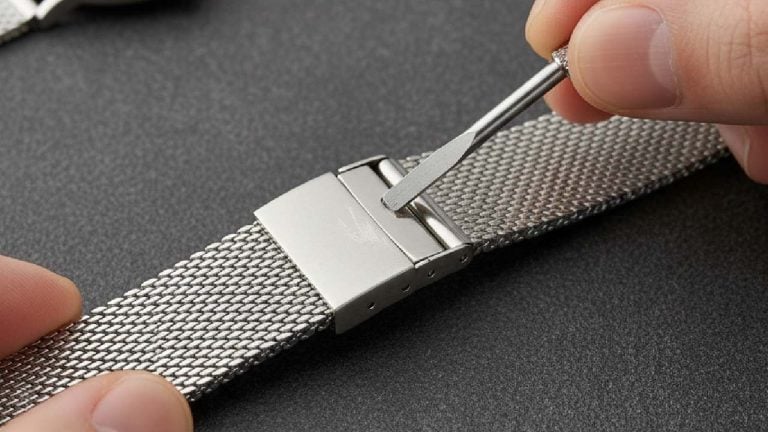
As we know, some models of modern watches, specifically those made of metal, have watch bands without pins. They are mainly based on clasp-adjustable bands and flexible link systems. Let’s check how to adjust these watch bands,

1: Identify the Adjustment Mechanism

The adjustment mechanism here relates to the type of band.

  • Mesh Bands with Sliding Clasp: Can be easily adjusted without needing to remove links.
  • Fold-Over Clasp Bands: Features adjustment slots and sections, but without pins.
  • Solid Metal Bands Without Pins: Features adjustable clasp movement along the band.

2: Adjustment Process

Adjusting Mesh Bands with Sliding Clasp:

  • Locate the clasp lock and lift it with the aid of a flathead tool.
  • Adjust the clasp along the mesh to position it where you want.
  • Once done, press the clasp back into the lock position.
  • Check the adjustment by wearing and make small changes as required.

Adjusting Fold-Over Clasp Bands:

  • Unlock the clasp and find the micro-holes for adjustment.
  • Gently slide the clasp into the slot to adjust the band size.
  • Once done, close the clasp again and test the adjustment to ensure it is correct.

Adjusting Solid Metal Bands Without Pins:

  • Open the clasp and find the clasp attachment point.
  • There will be a latch or a locking system with hooks.
  • Use a screwdriver or other compatible tool to lift or release the latch.
  • Once adjusted, gently press the lock back into place.

3: Working Tips

  • Work in a neat and clean environment.
  • Arrange sufficient lighting conditions.
  • Be gentle and calm. And don’t put extra pressure.
  • If anything is jammed, don’t attempt the procedure and seek professional assistance.
Reinserting Watch Band Pins

Steps to Reinsert Watch Band Pins

  • Align the watch band pins and link holes to ensure they are in alignment.
  • Insert the half pin using your finger and rest with the pin pusher tool.
  • Keep the pins in the same direction as they were before.
  • Once inserted, press gently with a finger or hammer tool to fit accordingly.
  • Bend the strap in different directions to confirm the smooth movement.
  • Final check everything, clean the straps, plus watch. It’s all done now,

Common Mistakes to Avoid

  • Be gentle and avoid excessive force in every single step of removing the watch band pins.
  • Keep an eye on the direction of pins as misalignment can cause damage.
  • Once pins are removed, store them in a small box or container.
  • Avoid using low-quality or incompatible tools during the procedure.
  • Don’t perform the procedure in low-light conditions or a dusty workplace.
DIY vs Professional Watch Repairing

Professional vs. DIY Removal Attempt

Professional Attempt

  • If you own a high-end and luxury watch.
  • If you lack the required tools and accessories.
  • If the pins or screws are jammed.
  • If the pins are misaligned or have bends.

DIY Attempt

  • If you have sufficient knowledge and the required tools.
  • If you want to save money and time.
  • If you are a watch lover or watch enthusiast.
  • If you want to learn and can bear the risk of damage.

Final Remarks

A thorough understanding of the various watch parts is essential before attempting any replacement or maintenance activity. Watch band pin removal is one of those parts that requires a skill set and detailed knowledge of watches. Moreover, one should also have relevant tools and accessories to perform the procedure. Similarly, if you own an expensive or high-end watch, it is recommended to seek professional assistance instead of attempting a DIY repair. Don’t forget to check the pin type before removal, as these pins operate on different mechanisms.