
The dial is often the part that makes a watch build feel like your own. You might already have a color or design in mind, but before ordering an NH35 dial, you need to know whether it will work with your case, movement, and hands.
A 28.5 mm dial is a common starting point, though size alone does not guarantee a fit. This guide explains what to check before buying, how date and no-date layouts change the finished watch, and when a ready-made or custom dial makes sense for your build.
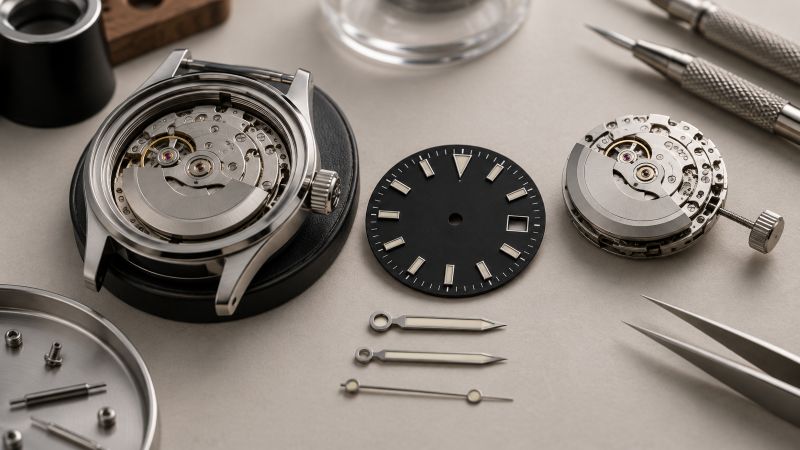
An NH35 dial needs to fit the case, sit flat on the movement, and leave room for the hands to move freely. If it has a date window, that opening must also align with the date wheel in the assembled watch. A matching diameter is only one part of the fit.
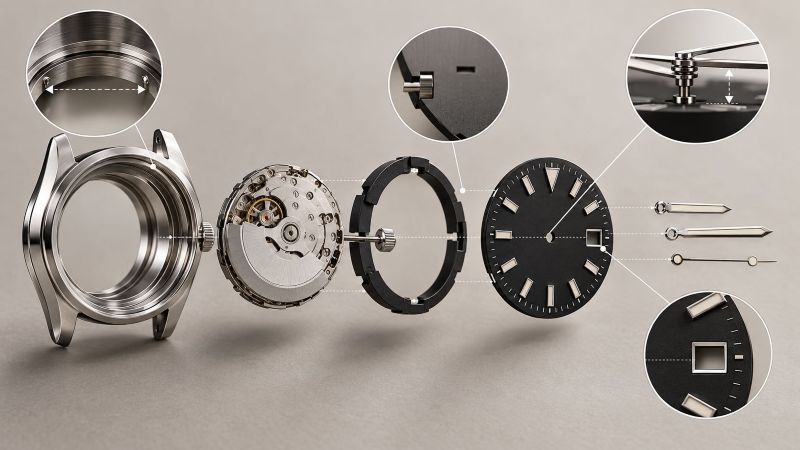
Interface | What to Check | Why It Matters |
Outer diameter | The case’s specified dial size or supported range | The dial must sit securely in the intended position |
Dial feet | Foot positions for the movement and case’s crown orientation | The dial must sit flat with its markers correctly aligned |
Date window | Opening position relative to the installed date wheel | The date should appear centered and fully visible |
Center opening | Clearance around the movement’s central components | The dial must seat without interference |
Thickness and marker height | Space beneath the hands and inside the case | The hands must clear the dial, markers, and crystal |
Many aftermarket NH35 dials are 28.5 mm in diameter. Check that measurement against the case’s dial specification, rather than its outside diameter. A larger case does not necessarily need a larger dial because the bezel and chapter ring can occupy more of the watch face.
The NH35A measures 27.40 mm across the movement itself and 29.36 mm across its dial holding spacer, according to the TMI NH35A specification and drawing. When choosing your dial, use the dial diameter specified for the case, which determines how the dial sits inside it.
A rear photo or drawing helps you identify the dial-foot positions. Some aftermarket dials include extra feet for different mounting orientations. Match the required pair to your movement and case before removing any unused feet.
The case’s crown position determines how the movement is oriented behind the dial. The dial feet and date window need to match that installed position so the hour markers sit correctly and the date appears centered. For a case listed with a crown at “3.8” or “4 o’clock,” confirm the matching dial-foot layout and date-window position with the seller.
The center opening also needs enough clearance around the movement’s central components for the dial to sit flat. Raised markers and applied logos should leave room beneath the hour hand.
Once the fit is confirmed, choose a layout you will enjoy wearing. The main decision is whether you want a visible date, followed by the markers, finish, and lume that give the watch its character.
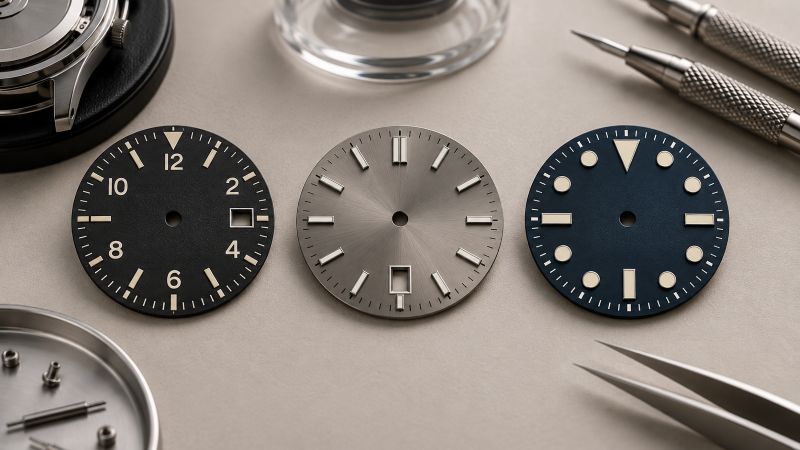
A date window is useful if you regularly check the date on your wrist. A 3 o’clock opening gives a familiar layout, while a 6 o’clock opening can create a more symmetrical face. For a 6 o’clock design, confirm that the date wheel’s printing is intended to read correctly through that window.
A no-date dial gives the markers an uninterrupted layout and can make the face feel simpler. It can cover an NH35’s date wheel, but the crown still retains its date-setting position. That extra position is expected when using a date movement beneath a no-date dial.
Neither layout is automatically better. If you use the date every day, keep it visible. If you prefer a balanced arrangement of markers, a no-date design may suit the watch you have in mind.
Think about how the dial will look beyond a close-up product photo. Clear numerals and strong contrast suit an easy-to-read field watch. Broad markers and distinct hand shapes work well for a dive-style build, while slim indices and a restrained finish can give a dress watch a lighter appearance.
Applied markers add depth; printed markers create a flatter look. Compare the dial’s finish with the hands you intend to use, especially when both are polished or reflective. A combination that looks attractive straight on may become harder to read at another angle.
For lume, consider both the daytime color and the illuminated color. Matching tones can help the dial and hands look consistent, while a deliberate contrast can also work. If nighttime readability matters to you, look for information about brightness and duration as well as color.
Some dials sold for related movements may work with an NH35, but the label alone does not establish compatibility. Check both whether the dial mounts correctly and whether its openings produce the display you want.
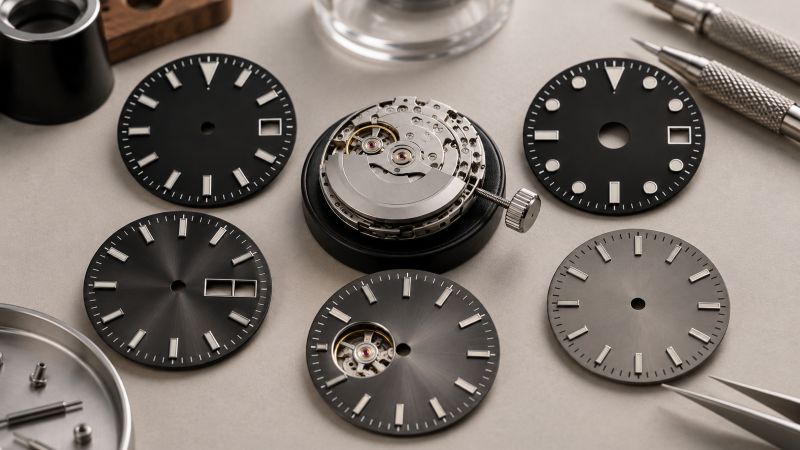
Dial Label | What to Check for an NH35 Build |
NH34 | Confirm mounting dimensions and the larger GMT center opening. Check whether the NH35 hand set will leave an unwanted gap visible around the center. |
NH36 | Confirm the aperture layout. A day-date opening will not show a functioning day display on the date-only NH35. |
NH38 | Distinguish a plain no-date dial from an open-heart design. An open-heart opening will not reveal the same view on an NH35. |
4R35 | Check the specific dial’s diameter, feet, date window, and thickness against your movement and case. |
SKX | Identify the model or aftermarket part specification. “SKX” is a watch-family label, not a complete dial-fit specification. |
Miyota 8215 | Treat it as a separate movement fitment unless the seller explicitly confirms NH35 compatibility. Compare the feet and date aperture rather than relying on diameter. |
The most useful listing identifies the actual dial variant. A product page may offer date, day-date, and no-date versions under several movement names, so check the selected option as well as the page title.
If a dial requires alteration, establish exactly what the alteration achieves. Removing or relocating feet may change how it mounts, but it does not correct the position or shape of a calendar opening. For a straightforward build, choose a dial whose mounting and display layout already match your NH35 arrangement.
Choose a hand set specified for the NH35, then compare its length, installed height, and finish with your dial. Movement compatibility tells you how the hands attach; the dial and case determine whether they have enough room and look well proportioned.
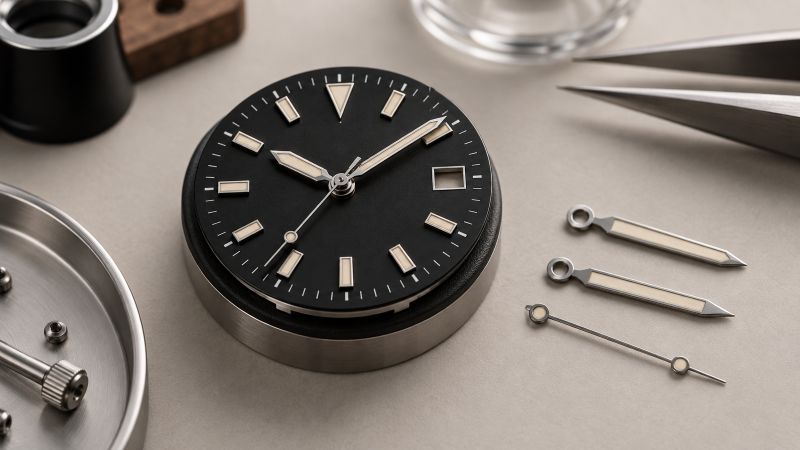
When browsing watch hands, check the stated caliber compatibility for the complete set. A familiar style or a matching hour hand does not confirm that the minute and seconds hands will also fit.
Hand length is measured from the center hole to the tip. The hour hand should point clearly toward the hour markers, and the minute hand should reach toward the minute track. Check the seconds hand’s tip and counterweight against the chapter ring and other nearby parts.
Installed height matters just as much. The hour hand must clear raised markers, the minute hand must pass above it, and the seconds hand must clear both. Allow for the crystal once the movement is inside the case. Check clearance throughout the hands’ travel, including where they overlap.
For appearance, compare the hands and dial under different angles of light. Dark hands can provide clear contrast against a pale dial, while polished hands may blend into a similarly reflective background. Matching lume tones can help the two parts feel like a set.
If you need help with measuring or fitting the set, Soflypart’s replacement watch hands guide explains the tools and installation checks in more detail.
Start with ready-made dials if you have found a design that suits your build. Choose a listing that identifies the exact variant and gives enough information to confirm fit. If a key detail is missing, send the seller your movement reference and case specification before ordering.
For a replacement, include the original watch reference and clear photos of the existing dial. For a new build, provide the case listing or drawing. This gives the supplier more useful context than a request for “an NH35 dial” alone.
A custom dial is worth discussing when you want your own logo, a particular finish, or a layout you cannot find among ready-made options. Soflypart’s watch dial customization service provides an inquiry route for discussing those requirements.
The right NH35 dial should fit the movement and case correctly while complementing the watch you want to build. Start by checking the case seat, dial feet, calendar aperture, center opening, and vertical clearance. Once compatibility is confirmed, you can focus on the color, markers, and date layout that bring your design together.
Ready to find a dial for your build? Contact Soflypart with your NH35 movement details, case specifications, and preferred style. We can help you explore suitable dial options and confirm availability before you order.
No. “Seiko NH35 dial” may describe an aftermarket dial made for an NH35 movement. The wording alone does not establish that Seiko manufactured the dial. If you need an original replacement, confirm the watch reference, part number, and stated origin with the seller.
Yes, if you have the tools and experience to handle the dial and fit the hands correctly. Keep the work area clean and protect the dial surface. If you are unfamiliar with hand fitting, a watchmaker can help avoid damage to the hands, dial, or movement.
Typical tools include a movement holder, hand-setting tools, a loupe, tweezers, and a dust blower. When replacing an installed dial, you also need hand-removal tools and a dial protector. Any required dial-foot alteration should be assessed separately before installation.
A custom dial maker may offer printed or applied logos. Confirm the available method and review the logo’s size and position alongside the markers and date window. An applied logo also needs enough clearance beneath the hands.