Product Description
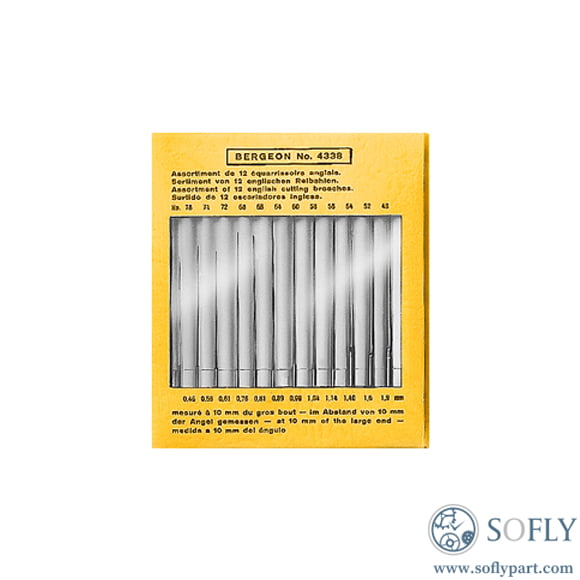
This is a genuine Swiss-made Bergeon 4338 cutting broach set, consisting of 12 tapered, high-quality steel broaches. The cutting ends range in diameter from 0.46 mm to 1.90 mm. These tools are designed to accurately enlarge, true, or clean out small, pre‑drilled holes in metal components. They are essential for tasks such as fitting pivot holes in watch movements, finishing gear train bores, and adjusting bracelet lug holes.
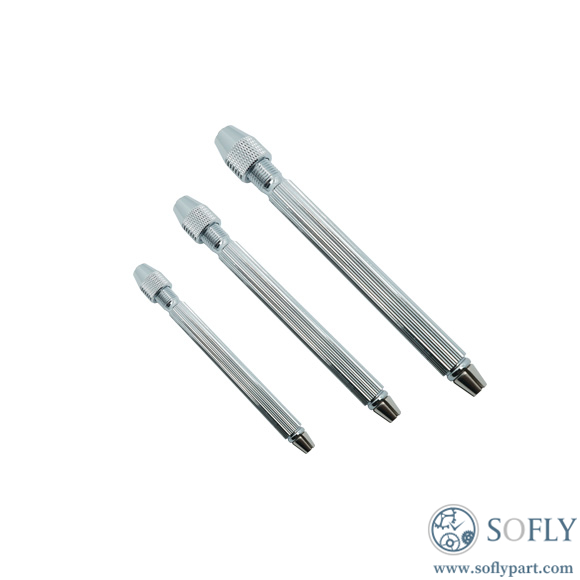
As a versatile set, it is a cornerstone tool for watchmakers, jewelers, and precision mechanics. Please note: this set does NOT include a handle. A handle or a pin vice (such as Bergeon 30086) must be purchased separately.
Features & Function
-
Material & Construction : Made from high-quality, hardened alloy steel to ensure sharp, durable cutting edges.
-
Tapered Profile : The broaches have a long, fine taper, with the diameter increasing from the tip. This allows a single broach to gradually enlarge holes to various sizes.
-
Pentagonal or Triangular Cross-Section : Bergeon cutting broaches typically feature a pentagonal or triangular shape, which provides efficient chip clearance and a cleaner cut compared to circular designs.
-
Precision Enlarging : Designed for manual use, removing microscopic amounts of material (microns) for ultimate control over the final hole size.
-
Versatile Applications : Ideal for fitting and enlarging jewel holes, truing plate holes, cleaning out burrs prior to riveting, and adjusting holes in soft metals like brass or plastics.
-
Handle Not Included : This set is intended as an expansion for a professional workshop. It does not include a handle, allowing users to choose their own pin vise or a dedicated broach handle (e.g., Bergeon 30086) for optimal control.
FAQ
Q1: What is the difference between a cutting broach and a smoothing broach?
A: A cutting broach (like this set) has sharp flutes and is used to enlarge a hole by removing material. A smoothing broach has a smooth or finely textured surface and no cutting edges; it is used after cutting to burnish, harden, and finish the bore for a smooth, accurate surface.
Q2: Why must you not turn a broach counter‑clockwise?
A: The cutting edges are relieved (angled) to cut effectively in only one direction. Reverse rotation can force chips into the finished surface, causing scratches and inaccuracies, and increases the risk of breakage.
Q3: The diameter ranges seem to overlap. How do I know which size to use?
A: Start with the smallest broach (0.46 mm), which should fit into the hole without resistance. Progressively move up through the sizes, testing the fit each time. If the next broach enters with slight resistance, it‘s the correct one to use. The overlap in sizes ensures a smooth progression and prevents you from trying to remove too much material at once.
Q4: Can I use this set for burnishing a balance staff pivot?
A: No, this set is for enlarging holes. Burnishing a balance staff pivot is a separate finishing operation that requires a Jacot tool or a watchmaker‘s lathe, not cutting broaches.
Q5: What should I do if a broach becomes dull?
A: Dull broaches can be sharpened by lapping them along the flutes on a flat stone charged with diamond paste. However, this requires professional-level skill, as it‘s impossible to visually confirm the correct geometry is maintained. Improper sharpening will ruin the broach.
Why Choose SOFLY Watch Parts?
-
Fast worldwide shipping within 3 business days.
-
Competitive pricing on Seiko/Hattori calibers.
-
3,000+ watch movements and parts in stock.
-
Trusted by watchmakers worldwide.
-
Personalized sourcing support via [email protected] or WhatsApp +86 18620212114.