
Choosing Seiko mod parts is easier when you know which components need to fit together. The movement determines the hand fittings and display functions, while the case sets the requirements for the crystal, bezel, and other exterior pieces. The dial connects both sides of that choice.
For a new build, start with the look and functions you want, then choose a movement and case that support them. If you already have a watch, case, or favorite dial, use its specifications to guide the remaining purchases.
This guide focuses on Seiko watch mod parts for NH34, NH35, NH36, NH37, and NH38 builds. It explains how to match the main components, decide between a kit and individual parts, and put together a shopping list for the watch you want to wear.
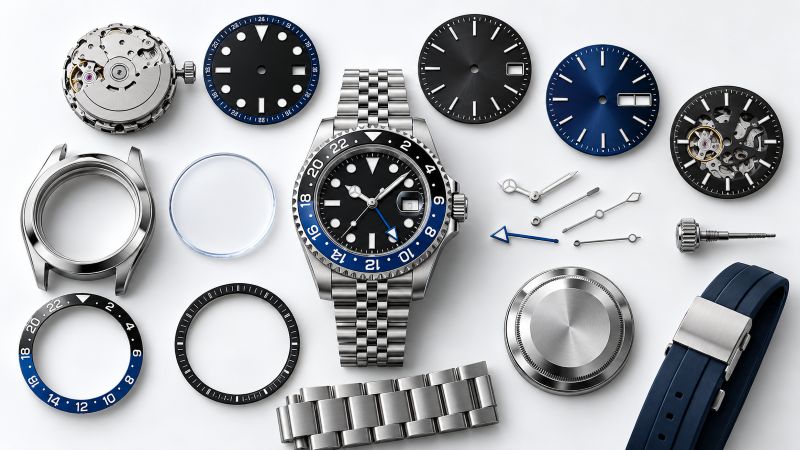
A complete NH watch needs a movement, dial, hands, case assembly, crown and stem, and a strap or bracelet. The case assembly also needs the correct crystal, caseback, seals, and movement support. Your shopping list depends on which of these pieces are already included.
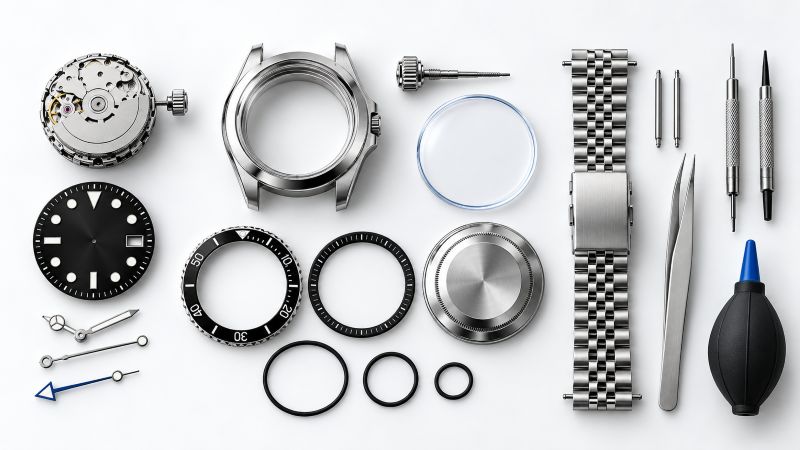
Separate the Seiko mod parts you need from design options and assembly equipment:
A case set may already include its crystal, crown, caseback, gaskets, and movement holder. Read the contents list before adding those items separately.
The parts list also changes with the movement. An NH34 requires a fourth central hand for its GMT display. An NH37 uses an additional hand for its 24-hour subdial. An NH38 needs a dial with an open-heart opening instead of a date window.
Starting with the movement gives every later choice a clear reference point.
A kit can reduce the number of separate fit decisions when its components are specified for one build. It is useful if you like the supplied design and want to spend less time comparing individual parts. Check whether “kit” means a complete watch build or only a case set, and whether tools are included.
Individual parts give you more control over the dial, hands, finish, and proportions. They also suit a project where you are keeping an existing case or movement. Build the list around those retained components and add the missing pieces.
Plan your watch repair tools alongside the parts. Fitting a dial and hands requires different equipment from installing a loose crystal, so the assembly work you intend to do should guide that purchase.
Choose the movement for the functions you want to use and the components you plan to keep. A date display, weekday display, or second time zone changes the parts you need around the movement.
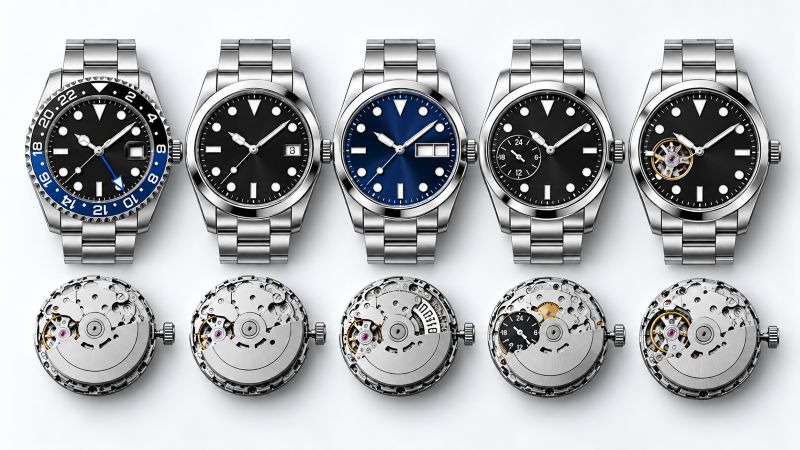
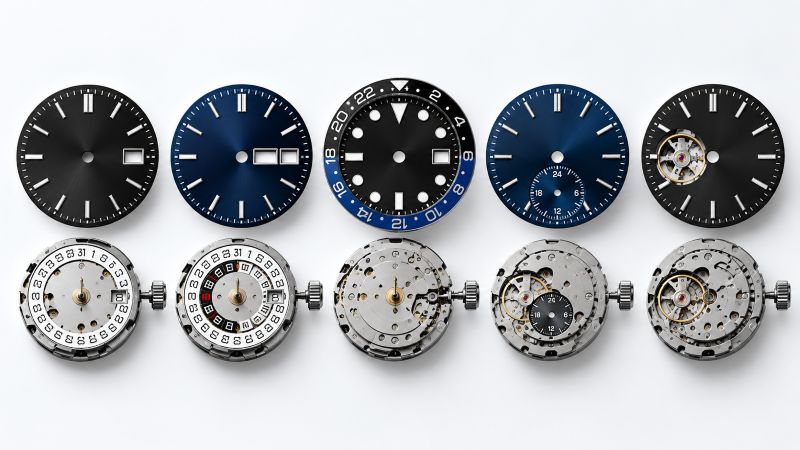
The Time Module NH series product line-up provides the starting point for comparing these functions:
Movement | Display and Function | What This Means for Your Build |
NH34 | Three timekeeping hands, a central GMT hand, and date | Choose a GMT-compatible dial and hand set, with room for the complete hand stack |
NH35 | Three hands and date | Suits a date watch; a compatible solid dial can also conceal the calendar |
NH36 | Three hands, day, and date | Use a matching aperture layout when you want both calendar displays visible |
NH37 | Three hands, date, and a 24-hour subdial | The subdial follows the main time and needs a matching dial and indicator hand |
NH38 | Three hands without a calendar, with provision for an open-heart display | Supports an open-heart design or a compatible solid no-date dial |
The distinction between the NH34 and NH37 is especially useful when planning the watch face. The NH34 lets you set its GMT hand to another time zone. The NH37’s 24-hour indicator follows the main hands, showing their position within the day.
For a clean no-date watch, consider whether you want a movement designed without a calendar or are happy to conceal an existing date display. That decision affects the crown operation as well as the dial.
Soflypart’s TMI watch movements category includes NH options to compare for your build. Once you have selected a caliber, use its exact specification to match the surrounding parts.
Cases designed for these NH movements need to support the selected caliber, dial size, and installed hand height. A suitable case holds the movement securely, aligns the winding stem with the crown tube, and leaves enough room beneath the crystal and caseback.
If you are buying a new case, start with its stated movement compatibility and the holder supplied or specified for it. If you are keeping an existing watch case, use its case reference and current movement as the starting point. This helps you identify which parts can stay and which need to change.
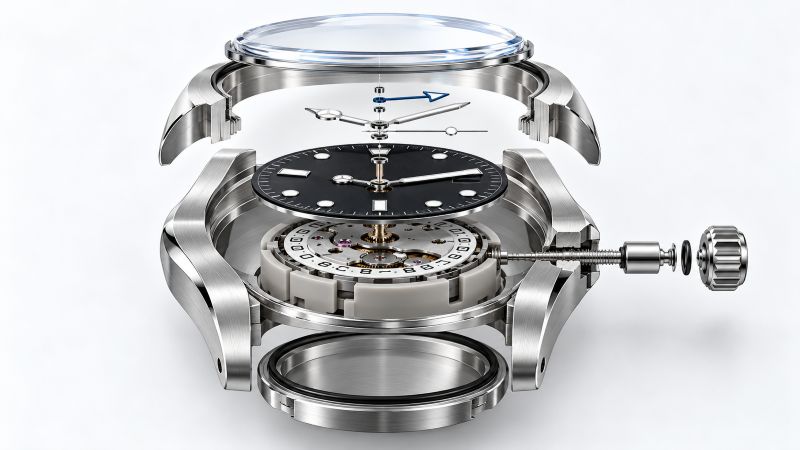
The movement holder or spacer locates the movement inside the case. With the assembly seated correctly, the stem should align with the crown tube without being forced sideways. The caseback must also close with enough room for the movement and rotor.
Crown position affects how the movement sits behind the dial. A case with its crown at 3 o’clock can require a different dial-foot arrangement from one with the crown near 4 o’clock. Match the dial’s mounting and calendar orientation to the intended case configuration.
Some cases are offered for the NH35, NH36, and NH38. When comparing these options, check that the selected case version and movement holder support your chosen caliber. A listing that offers several configurations may supply different components with each option.
For an NH38 open-heart build, the case still needs to accommodate the movement and complete dial-and-hand assembly. The dial’s cutout is a separate match to the balance position, covered in the dial section below.
An NH34 build needs room for its four central hands. When considering a case also sold for the NH35, confirm that the exact configuration supports the NH34’s installed hand stack, including the specified crystal and movement holder.
Consider the dial, raised markers, hands, chapter ring, and inner crystal profile together. A case’s outside thickness or a domed crystal alone does not establish the clearance available inside.
Once you have chosen the case, keep its model and specifications with your parts list. Use those details when selecting the crystal, bezel, crown, caseback, and bracelet.
Match the dial to both the movement and the case. Its diameter must suit the case, its mounting must hold it in the correct orientation, and its openings must align with the features you want to display.
A 28.5 mm dial is common in NH builds, but the case specification determines the size to buy. The chapter ring or inner case opening also affects how much of the dial remains visible, including its minute track and outer markers.
A rear photo or drawing helps establish the dial-foot positions. Some aftermarket dials carry extra feet for different mounting orientations. Identify the intended pair for your case and movement before any alteration. The dial should sit flat with its 12 o’clock marker correctly positioned relative to the case.
For a date display, the aperture must frame the date wheel in its installed orientation. To show both day and date on an NH36, the opening or openings must expose both discs correctly. The chosen day-disc language and printing orientation also need to suit the finished layout.
An NH34-compatible dial needs sufficient central clearance for the GMT assembly. A usable 24-hour scale can be placed on the dial, chapter ring, or a suitable bezel. An NH37 display instead requires the indicator-hand opening and subdial scale in the position specified for that movement.
For an NH38 open-heart design, align the cutout with the balance. A compatible solid dial can cover that area if you prefer a plain no-date face. Similarly, a solid dial can conceal an NH35 calendar, although the movement retains its date-setting crown position.
Consider the dial from the side as well as the front. Its base thickness, applied markers, and logo all affect the space available beneath the hands. A dial that mounts correctly still needs to work with the selected hand height and case interior.
Choose a hand set with the correct fittings for your caliber, then match its length and installed height to the dial and case. The movement determines how the hands attach; the surrounding parts determine the room they have to move.
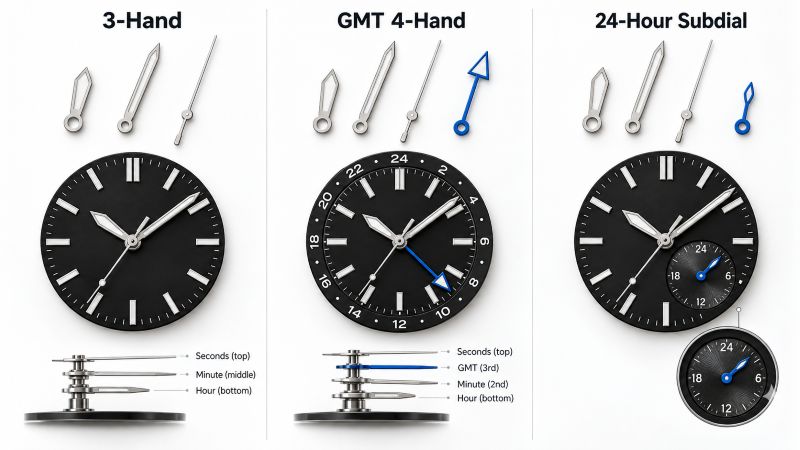
When comparing watch hands, check the complete set and its included pieces. A three-hand set does not include the NH34’s GMT hand or the NH37’s subdial indicator unless those additional hands are expressly supplied. Each extra hand needs the fitting intended for its position.
Hand length is normally measured from the center of the mounting hole to the tip. The hour hand should point clearly toward the hour markers, while the minute hand should approach the minute track. Compare those lengths with the visible dial area, and allow room for the seconds hand’s tip and counterweight.
Height is a separate fit requirement. The lowest hand must clear the dial and raised details, each hand must pass the others, and the uppermost hand must remain below the crystal. The assembled watch needs clearance throughout the hands’ travel, including where they overlap.
Once those dimensions work, choose a finish that remains readable against the dial. Polished hands can blend into a reflective background at certain angles. Matching the dial and hand lume can give a consistent appearance, but daytime color and illuminated color are separate choices.
Soflypart’s replacement watch hands guide explains measurement and fitting in more detail if you are preparing to install the set.
Match exterior parts to the exact case model or a clearly specified compatible case design. The case determines their seating surfaces, attachment points, and dimensions.
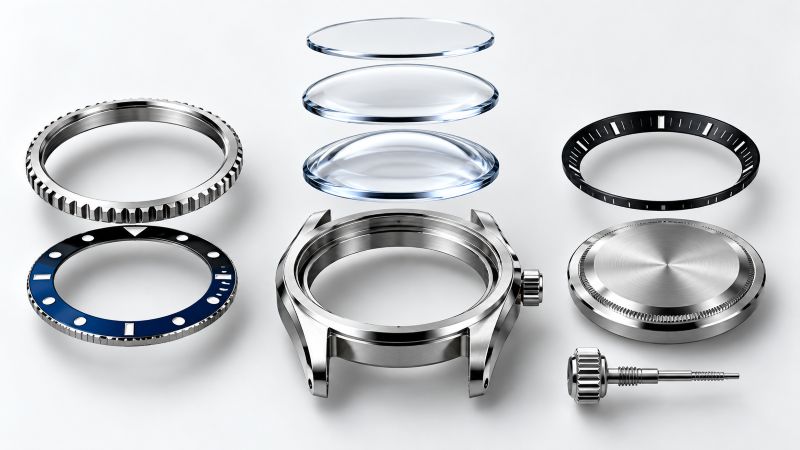
The crystal needs the correct diameter, edge profile, thickness, and gasket arrangement. Its inner surface also affects hand clearance. An outward dome alone does not establish how much space is available underneath, so use the crystal profile specified for the case.
The bezel must match the case’s mounting and retention system. Its insert then needs the correct outer diameter, inner diameter, and profile for that bezel. A familiar appearance or nominal watch size gives less fit information than those interfaces.
Where the case uses a separate chapter ring, match its dimensions and locating features. Its inner opening controls the visible dial area, and any printed minute markings need to align with the dial.
The crown must suit the case tube and the selected stem connection. A screw-down crown also needs the matching tube thread. Casebacks similarly depend on the case’s attachment design, while each gasket needs the correct seating dimensions.
These pieces work together to seal the watch. Treat water resistance as a property of the completed assembly, supported by appropriate pressure testing after the work is finished.
Lug width is the starting measurement for a strap. Spring-bar size and available clearance also matter at the attachment.
A fitted bracelet adds another requirement: the end links must follow the case shape and line up with its spring-bar holes. Two cases with the same lug width can require different end links. For an existing watch, use the case reference when searching for a fitted bracelet.
Before ordering, compare the exact variants in your basket with one complete build list. This final pass helps catch missing pieces, duplicated purchases, and options that belong to a different configuration.
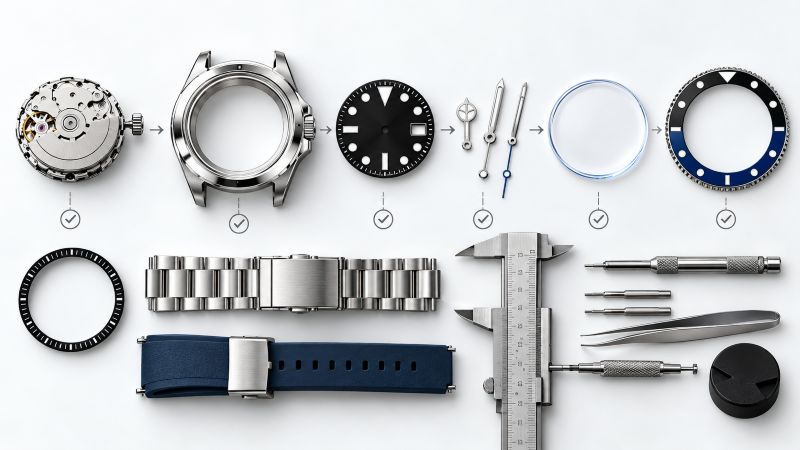
Use these five checks for your Seiko mod parts order:
For example, a photo may show several hand colors while the selected option supplies only one set. A case-and-bracelet package may also have different contents from the case-only version. Save the selected specifications with your order so you can refer to them during assembly.
If an essential measurement or included item is unclear, resolve that point before buying. A useful inquiry gives the supplier the exact movement and case reference, the part you want, and the dimension or fit question that needs an answer.
Choose Seiko mod parts around the functions you want and the components you plan to keep. The NH34 suits a GMT build, the NH35 a date watch, the NH36 a day-date layout, and the NH37 a 24-hour subdial. The NH38 suits a no-date build, with an open-heart dial if you want the balance on display.
Use your chosen case to guide the exterior parts, then match the dial and hands to the movement and available space. If you already have a case or a favorite dial, let that piece guide the remaining choices.
Ready to build a watch that feels like yours? Explore Soflypart’s TMI watch movements and choose the caliber that suits your plan, or browse the parts linked above to complete a build you have already started.
Some are genuine replacement parts, while others are aftermarket components made for particular movements or cases. “Seiko mod parts” describes the intended use and does not establish who made the part. Look for a clear origin statement and a part number when buying an original replacement.
No. You can assemble a watch from a compatible NH movement and separately purchased components. If you are modifying an existing Seiko, its case reference and fitted movement provide the starting specifications.
No. NH compatibility describes a particular relationship to the movement. Exterior parts still need to match the watch’s case, and the dial and hands must suit the complete assembly. Use the exact case and caliber references to narrow the choice.
Often, you can keep the existing movement when changing compatible hands, a dial, or exterior parts. A change in display function or an incompatible replacement component may require a different plan. Decide what you want to keep before ordering.