
A dry watch pressure tester is usually the better choice for routine pass-or-fail screening because the watch stays out of water. A wet tester is more useful when you need to locate a leak, as escaping bubbles can identify the affected area. That visual diagnosis requires careful control of the pressure and release sequence.
The right watch waterproof tester depends on the watches you service, the pressure range you need, and how often you perform tests. This guide compares dry and wet testing, explains the safe workflow for each method, and helps you choose a tester that fits your repair bench.
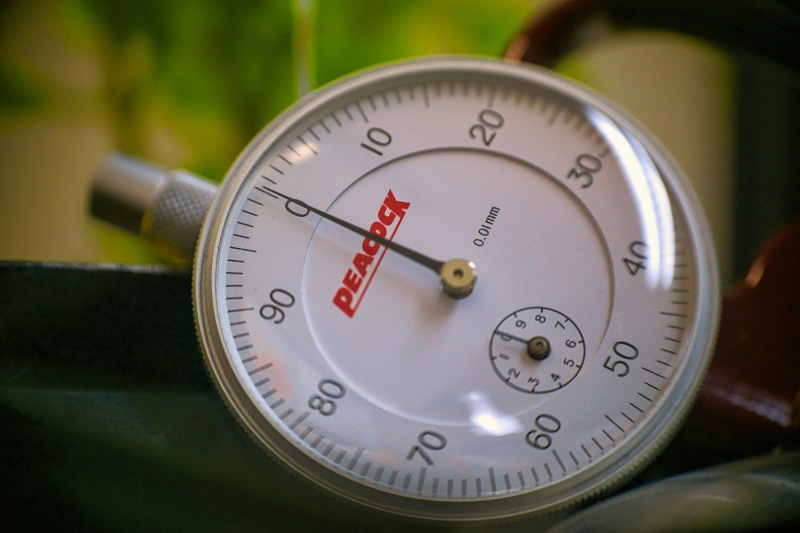
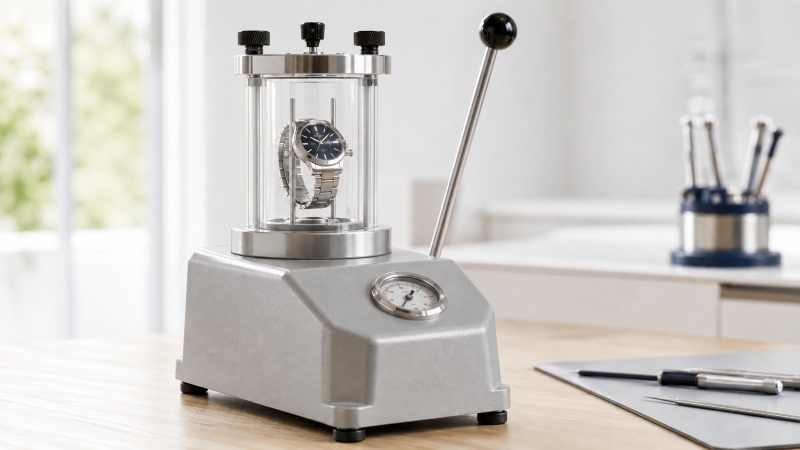
A watch pressure tester shows whether a closed watch case maintains its seal at the selected test pressure. A dry tester normally reports whether the case passes or fails, while a wet tester can also show where air escapes around the crown, crystal, pushers, or case back.
These sealing points work as one system. Replacing a case-back gasket will not resolve leakage from a worn crown seal or a poorly seated crystal. Pressure testing reveals problems that may remain invisible during a visual inspection.
Test the case after assembly and after work that opens or changes its sealing system, including battery, crystal, crown, pusher, and gasket replacement. Recording the pressure, method, and result gives the test a clear reference if the watch returns for later service.
A passing result applies to the pressure, procedure, and case condition used during that test. ISO 22810:2010, Horology: Water-resistant watches establishes broader requirements and test methods for verifying water resistance. A workshop result should therefore be recorded with its actual test conditions.
A pressure tester evaluates the sealed case. A timegrapher measures rate, amplitude, and beat error in a mechanical movement. A serviced mechanical watch may need both checks because they evaluate different parts of the finished watch.
A dry watch pressure tester detects leakage without placing the watch in water. A wet tester submerges the pressurized case during observation so that escaping bubbles can reveal the leak location. The choice depends on whether you need routine screening or visual diagnosis.
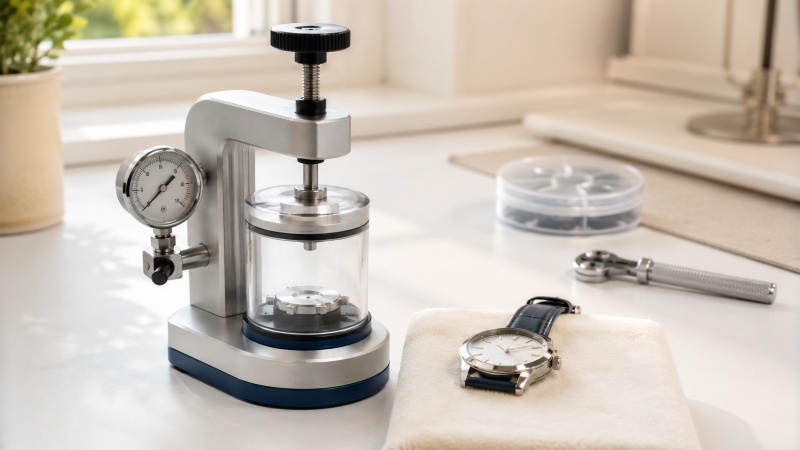
A dry tester creates a pressure difference between the watch and the surrounding chamber by using vacuum, positive air pressure, or both. Its measuring system follows the small deformation of the case or crystal. Pressure compensation or an unexpected change in deformation indicates leakage.
Electronic dry testers may automate the pressure, stabilization, measurement, and release stages. This supports repeatable checks after battery replacement, case opening, or other routine service while keeping the watch out of water.
The result usually confirms whether the case passed the selected program. When it does not identify the exact entry point, the crown, crystal, pushers, and case back still require inspection or a separate leak-location procedure.
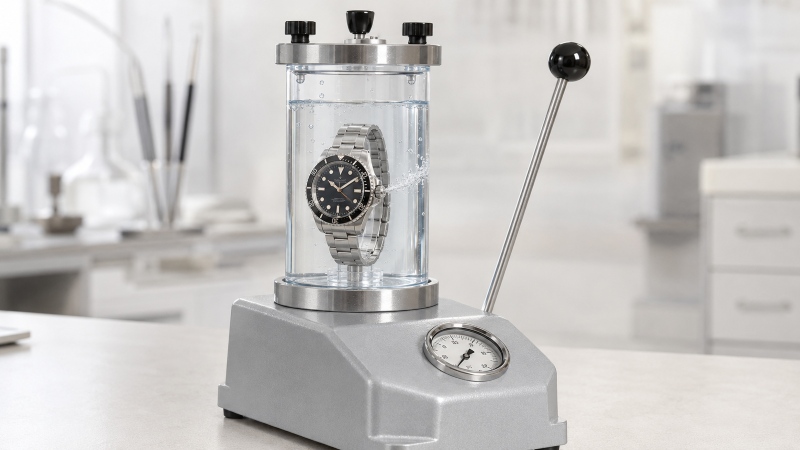
A wet tester first pressurizes the watch while it remains suspended above the water. The operator then lowers it below the surface and releases the chamber pressure according to the equipment instructions. Air that entered through a leak during pressurization escapes from the same area as the pressure falls, producing a visible stream of bubbles.
The bubble location directs the next inspection. Bubbles at the crown point toward the crown seal or tube, while bubbles around the crystal edge point toward the crystal installation and gasket. This makes wet testing useful when finding the source matters as much as confirming the failure.
The following table connects each watch pressure tester method to its practical role:
Factor | Dry Tester | Wet Tester |
Water Contact | The watch remains dry | The case is submerged during observation |
Measurement | Case deformation or pressure compensation | Escaping bubbles |
Main Result | Pass, fail, or numerical reading | Visible leak location |
Controls | Model-specific manual or automatic program | Manual pressure and release sequence |
Best Use | Repeatable intake and final screening | Leak diagnosis and manual bench testing |
Main Constraint | May require another step to locate the leak | Depends heavily on correct operator technique |
Choose a dry tester when you need frequent, repeatable screening without water contact. Choose a wet tester when you need to see where the case leaks. A workshop equipped for both can run a dry test first and use a wet test to trace a failed result.
Use either tester within the limits of the watch, the machine, and the manufacturer’s procedure. The two methods share the same starting point: inspect the case, confirm the seals are seated, and choose a test that fits the watch’s intended rating and condition.
Old crystals, damaged cases, weak snap backs, and unknown service history need extra care. Start with a sound case and a procedure you can document.
A dry test starts with a visual inspection of the crown, crystal, pushers, case back, and visible gaskets. Once the case is closed, position the watch and measuring probe as the machine manufacturer specifies. Poor contact between the probe and crystal can produce an unreliable reading.
Next, select a vacuum or positive-pressure program that suits the watch and your workshop procedure. Let the machine finish its stabilization, measurement, and pressure-release stages without moving the case. The display may show a pass, failure, leak rate, or deformation result, depending on the tester.
Record the program, pressure, and final reading. Repeat the cycle with the same setup when a result appears marginal or inconsistent. An electronic tester may automate the measurement, but accurate results still depend on case preparation, probe position, and program choice.
A manual wet test must follow the correct sequence. The watch receives air pressure above the water before it is submerged, and the operator observes it while releasing that pressure.
Testing an empty case is a useful precaution when you suspect a major leak or want to protect a valuable movement during diagnosis. A complete watch can be tested when its case is sound and the equipment is designed for that procedure.
Interpret a watch pressure tester result by considering where the indication appears, whether it continues, and whether the full test procedure was completed. An isolated bubble and a repeated stream from the same location do not provide the same evidence.
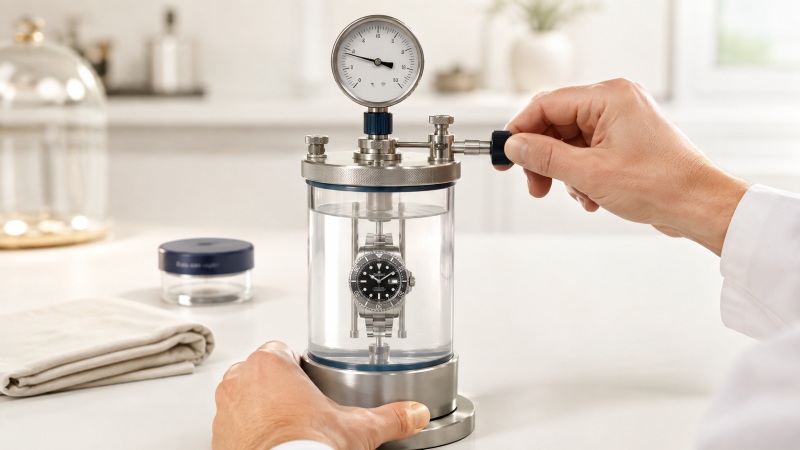
During a wet test, air trapped around bracelet links, bezel gaps, crown recesses, and the case-back edge may produce a few bubbles that stop quickly. This does not automatically confirm a leak, but the area should be observed again. Bubbles that repeatedly emerge from the same sealing point as the pressure falls are a stronger indication of leakage.
The bubble location identifies the area to inspect rather than proving which individual component has failed:
Observation | Area to Inspect | Next Check |
Repeated bubbles at the crown | Crown seal, tube, or stem alignment | Remove the watch as directed, inspect the crown assembly, and retest after correction |
Repeated bubbles along the case-back edge | Gasket seating or sealing surface | Inspect the gasket, groove, and mating surfaces |
Repeated bubbles around the crystal perimeter | Crystal gasket or crystal seating | Check the crystal installation and surrounding seal |
Repeated bubbles at a pusher | Pusher seal or tube | Inspect or service the affected pusher before retesting |
A few isolated bubbles that stop | Possible air trapped in an external recess | Continue observing and repeat the test if the result remains uncertain |
No bubbles after an incomplete pressure stage | Inconclusive test | Repeat the complete manufacturer-specified procedure |
Dry-test results also depend on a consistent setup. If the reading is marginal or unexpected, check the watch support, probe position, and selected program before repeating the test under the same conditions. A repeatable failure indicates that the sealing system needs inspection, even when the machine cannot identify the exact leak location.
Treat each outcome according to the strength of the evidence. Record a clear result, repeat an inconclusive test with the correct setup, and inspect and repair the case before retesting a confirmed failure.
Choose the testing method before comparing maximum pressure. A dry watch pressure tester is the stronger choice when you need repeatable pass-or-fail screening without water contact. Choose a wet tester when locating the source of a leak is part of the job.
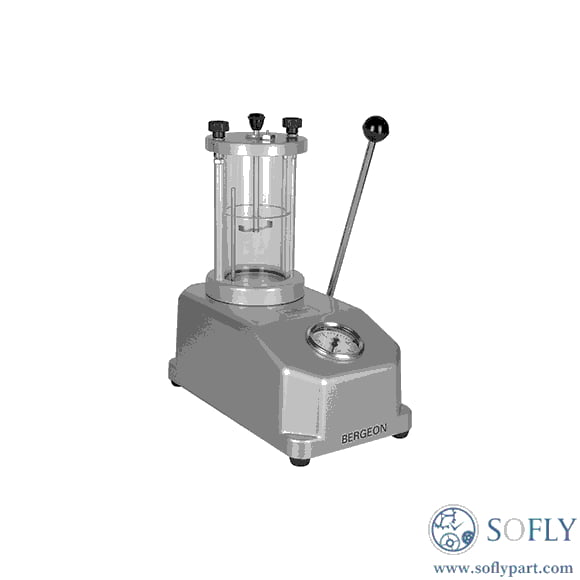
Once the method is clear, check four practical limits:
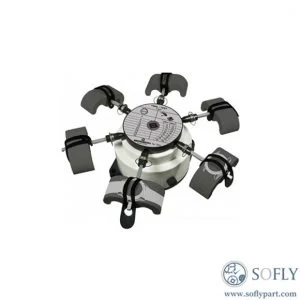
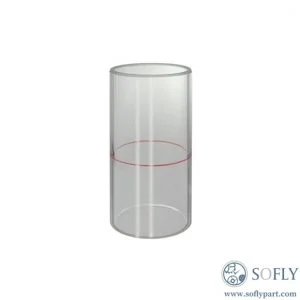
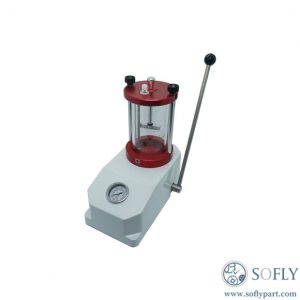
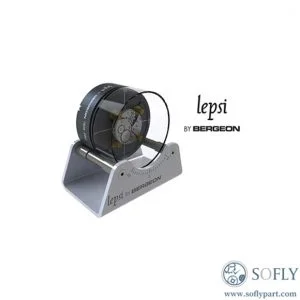
Soflypart currently lists the following options:
Model | Published Configuration | Selection Relevance |
Up to 3 ATM, capacity for two watches, with distilled water advised | Suitable when two-watch capacity matters within a lower test range | |
Listed as a manual-pump, dry-air tester with a maximum pressure of 6 bar | An option for manual dry-air testing without an electronic system | |
Up to 10 ATM with a connection for an external compressor | Suitable for a professional bench that needs a wider range and already has a compatible air supply |
These models do not form a simple low-to-high upgrade path. Their testing method, capacity, and air requirements determine whether they fit your workflow. Select the method that produces the evidence you need, then choose the pressure range and setup that can deliver it safely.
You can review these models alongside other diagnostic equipment in Soflypart’s watch tester collection.
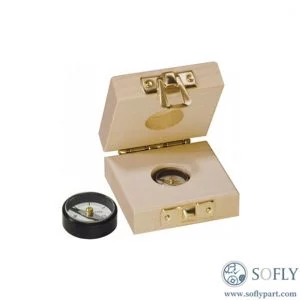
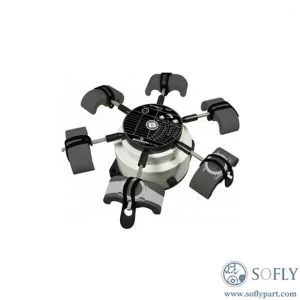 Out of Stock
 Out of Stock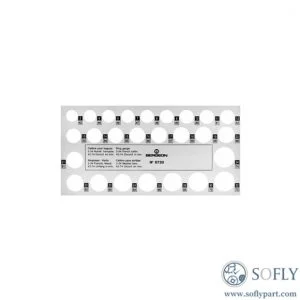

The dry vs. wet watch pressure tester choice comes down to what you need to learn from the test. Choose a dry tester when your priority is consistent pass-or-fail screening without water contact. Choose a wet tester when you need visible bubbles to guide you toward the source of a leak.
The real goal is to finish case work with evidence you can trust. Decide what result you need first, then match the testing method, pressure range, and bench setup to that purpose. With careful case preparation and the correct procedure, pressure testing becomes a reliable part of the repair rather than a final box to check.
Once you know whether your bench needs routine screening, visible leak diagnosis, or both, explore Soflypart’s watch tester collection and choose a setup that supports the way you actually work.
Only use a tester at home if its manufacturer permits that use and you understand its pressure and release procedure. Equipment designated for professional use should remain on a properly trained bench.
Yes, provided the case fits the machine and the selected pressure is appropriate. A watch pressure tester evaluates the sealed case, so the movement type does not determine the testing method.
Check that both tests used the intended pressure and completed their full cycles. Repeat each test with the same setup; if the conflict remains, do not approve the case until the sealing system and test procedure have been inspected.