
If you’ve ever seen “17 Jewels” or “21 Jewels” printed on a watch dial, you probably wondered:
Are those real gemstones? Does a higher number mean better quality?
The short answer is: no—and not necessarily.
If jewel count alone defined quality, then 30 jewels would always beat 17. But watchmaking doesn’t work that way.
Watch jewels are tiny synthetic ruby bearings placed inside the movement to reduce friction. They improve efficiency, reduce wear, and extend service life. But jewel count alone does not determine how good a watch is.
To truly understand what those numbers mean, we need to look at:
Let’s start inside the movement.

Watch jewels are synthetic ruby bearings that reduce friction between moving metal components inside a mechanical movement.
They are not decorative stones. They are precision engineering parts.
Modern watch jewels are:
In mechanical watches, steel pivots rotate thousands of times per hour. Without jewels, those pivots would wear directly into brass plates. Over time, pivot holes would enlarge, friction would increase, and accuracy would decline.
Jewels act as low-friction sleeves. They preserve both alignment and efficiency.
In other words, they’re not cosmetic—they’re structural.

Mechanical watches rely entirely on physical energy transfer.
Power flows from the mainspring → through the gear train → into the escapement → to the balance wheel.
Every wheel rotates on fine steel pivots. When steel rubs against brass or steel, three things happen:
Even minor friction changes affect balance amplitude. Reduced amplitude directly impacts accuracy.
Jewels solve this by:
Instead of metal grinding on metal, pivots rotate inside polished ruby bearings.
That single engineering choice dramatically increases long-term durability.
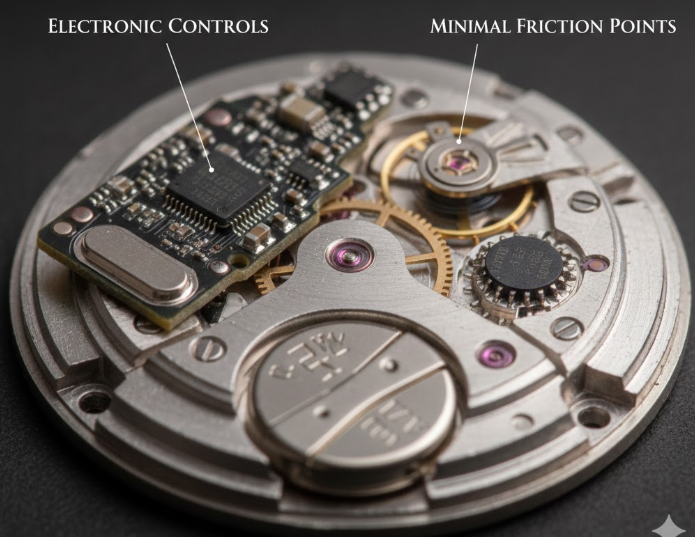
Quartz watches rely primarily on electronics rather than mechanical transmission.
Mechanical watches depend on:
Quartz watches depend on:
Fewer moving parts mean fewer friction points.
Here’s a practical comparison:
Watch Type | Typical Jewel Count |
Basic Quartz | 0 |
Mid-Range Quartz | 1–3 |
Quartz Chronograph | 5–13 |
Manual Mechanical | 17–21 |
Automatic | 21–25 |
Mechanical Chronograph | 25–35 |
Fewer jewels in quartz does not mean lower quality. It reflects a completely different design philosophy.
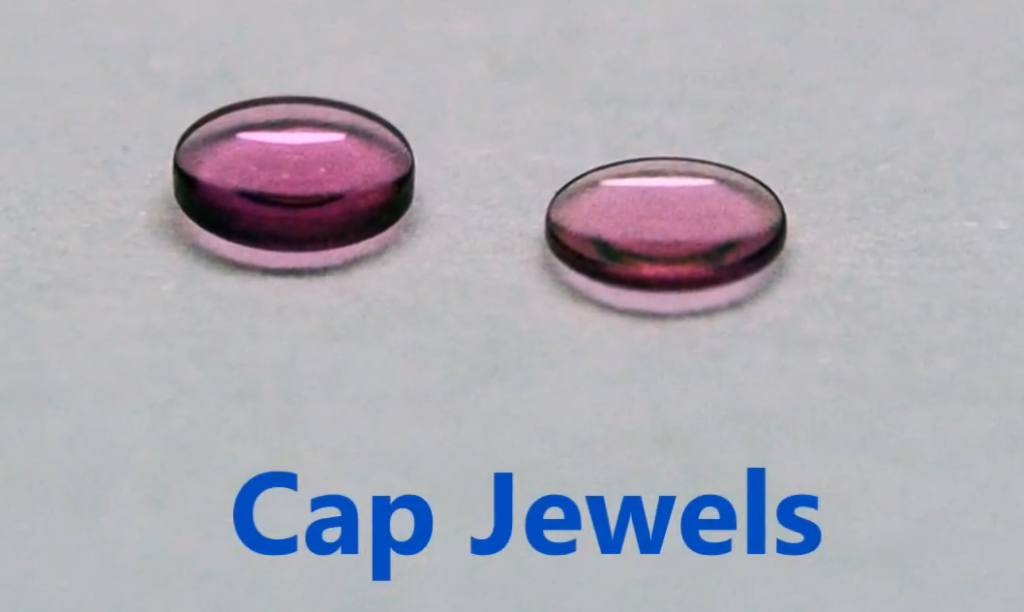
Jewels are placed at high-friction pivot points.
There are two primary types:
Let’s examine key locations.
This is the heart of the movement.
Jewels appear in:
Shock protection systems such as Incabloc or KIF protect these delicate jewels from impact damage.
Each major wheel typically rotates inside jeweled bearings:
These jewels maintain efficient torque transfer from mainspring to escapement.
Automatic watch movements add jewels to support:
For example, ETA 2824 uses 25 jewels while Seiko NH35 uses 24 jewels.
The difference reflects architecture—not superiority.
The number printed on the dial refers to the total count of functional ruby bearings inside the movement.
Historically, 17 jewels covered all essential friction points in a manual-wind movement:
This was considered “fully jeweled.”
A properly built 17-jewel movement can run reliably for decades.
Common in automatic movements.
Additional jewels support:
Higher counts appear in:
However:
More jewels only help if they reduce necessary friction.
After essential pivot points are jeweled, additional stones do not improve accuracy.
During the mid-20th century, some manufacturers advertised watches with “75 jewels” or even “100 jewels.”
Many of those additional jewels were placed in non-functional areas simply to inflate the number.
Eventually, U.S. regulations required jewel counts to reflect functional bearings only.
This history explains why jewel count can sometimes be misleading.
Architecture matters more than arithmetic.
No.
True movement quality depends on:
A well-engineered 17-jewel movement can outperform a poorly designed 30-jewel movement.
Jewel count reflects movement layout—not craftsmanship level.
Modern watch jewels are synthetic ruby.
Synthetic ruby offers:
Early watches sometimes used natural ruby, but synthetic stones provide better stability and lower cost.
Diamond is harder—but unnecessary, expensive, and more difficult to machine precisely.
Ruby provides the ideal balance.
Yes—but indirectly.
Jewels:
However, jewels do not eliminate maintenance.
Lubricants degrade. Oils dry out. Service still matters. Think of them like engine bearings in a car—they reduce wear, but oil changes still matter.
Proper lubrication and careful servicing play just as important a role as jewel count. During maintenance, correct oil application and stable movement support prevent unnecessary stress on pivot jewels.
Using stable movement holders and calibrated screwdrivers—tools typically found in professional watch repair parts—helps preserve jewel alignment and long-term performance.
Rare—but possible.
Common causes include:
Balance jewels are especially delicate.
In workshop practice, jewel damage often happens during amateur servicing when a screwdriver slips or a bridge is lifted unevenly.
That’s why professional watchmakers rely on properly sized drivers, watch
movement holders, and jeweling tools. Precision matters at this scale.
If you’re learning watch repair or servicing your own movement, investing in professional-grade tools—such as those offered by Soflypart—significantly reduces the risk of cracking or misaligning delicate jewel settings.
At this level, even a fraction of a millimeter matters.
No.
Modern watch jewels:
They are engineering components—not gemstones.
Not necessarily. Luxury status relates to finishing, craftsmanship, and brand positioning—not jewel count alone.
Yes. For manual-wind movements, 17 jewels cover all essential friction points.
Smartwatches rely on electronics, not mechanical gear trains.
Not directly. But unnecessary jewels add cost and complexity without improving function.
Jewels in a watch are about friction control—not decoration.
They protect pivots, stabilize performance, and extend movement life. But jewel count alone does not define quality.
When evaluating a watch, focus on movement architecture, engineering precision, and service history—not just the number printed on the dial.
In watchmaking, small components quietly protect everything else.
Those tiny ruby bearings don’t sparkle on the outside—but they determine how smoothly everything runs inside.
And the next time you see “21 Jewels” printed on a dial, you’ll know it represents engineering—not marketing glitter.