
A single scratch across your watch crystal can make an otherwise perfect timepiece look ten years older.
If you’ve ever noticed swirl marks under bright sunlight, you know how distracting even minor scratches can be.
The good news? Many light scratches can be polished at home — if you use the right method for your crystal type.
In this guide, you’ll learn:
Before touching any polish, though, you need to identify the crystal type. That decision changes everything.
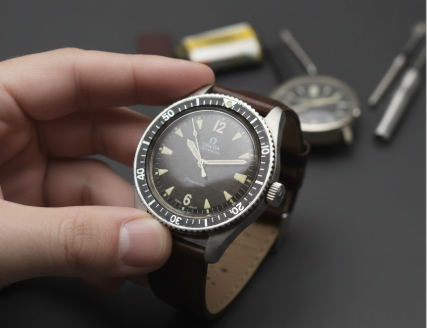
The watch crystal is the transparent cover that protects the dial. There are three primary types, and each behaves very differently when scratched.
Acrylic is forgiving and ideal for DIY polishing. In many cases, light scratches disappear in minutes.
Because acrylic removes material evenly, it’s the safest crystal type for first-time polishing attempts.
Mineral glass can sometimes be improved, but results depend on scratch depth.
If the scratch catches your fingernail, polishing usually won’t eliminate it completely.
Sapphire rarely scratches — but when it does, removal is challenging and sometimes impractical.
For deep sapphire damage, replacement is often more realistic than refinishing.
Identifying the material first prevents costly mistakes later.

If you’re unsure, gently drag a fingernail across the scratch. If it catches, polishing likely won’t remove it.
That quick test can save you hours of unnecessary effort.
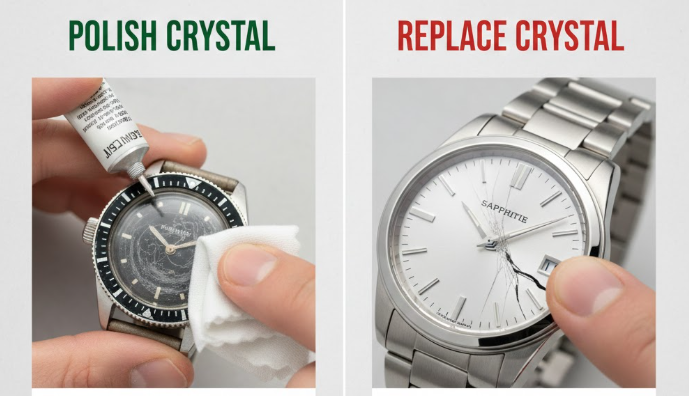
Understanding the cost difference helps guide your decision.
Typical replacement costs:
Polishing compounds usually cost under $20.
For acrylic crystals, polishing is often the obvious choice. For sapphire, professional refinishing can approach replacement cost — making a new crystal the smarter investment.

Before polishing, gather proper supplies. The right tools reduce risk and improve results.
If you remove the crystal or open the case, stable support becomes critical. Purpose-built watch repair tools — such as crystal presses, case holders, and calibrated screwdrivers from specialists like Soflypart — help prevent slipping or uneven pressure during handling.
At this scale, precision matters more than strength.

Acrylic is the most forgiving material and ideal for beginners.
Remove dirt and oils with a microfiber cloth.
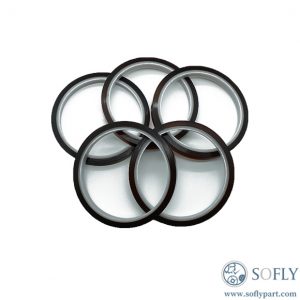
Apply masking tape around the bezel and lugs.
Place a small amount of PolyWatch onto the crystal.
Use moderate pressure for 2–3 minutes.
Check under bright light.
Most light scratches disappear after one or two cycles.
Acrylic responds best to steady polishing rather than heavy pressure. Think controlled, not aggressive.
That’s why many collectors actually prefer acrylic — it’s maintainable.
Mineral glass requires patience.
Use alcohol to remove debris.
Protect case surfaces completely.
Use a felt pad or polishing cloth.
Hand polishing works for very light scratches.
For better results, use a rotary tool at low speed.
Stop regularly to check progress.
Mineral scratches may improve but rarely disappear completely.
If results plateau after 20–30 minutes, replacement is usually more efficient.
Sapphire is extremely hard — which is why it rarely scratches.
But when it does:
DIY polishing may slightly reduce light scuffs, but deep scratches require significant material removal.
In many cases, professional sapphire refinishing costs nearly as much as replacement. For severe gouges, installing a new crystal is often the smarter choice.
Many modern sapphire crystals include anti-reflective (AR) coating.
If a scratch appears slightly bluish or purple under certain lighting angles, it may be on the AR coating rather than the sapphire itself.
Polishing sapphire aggressively can remove coating unevenly, causing patchy reflections.
If you suspect coating damage, consult a professional before polishing. Removing AR coating requires a different approach than crystal resurfacing.
This is one of the most commonly misunderstood issues in DIY polishing.
Polishing is simple — but easy to do wrong.
Toothpaste is inconsistent and may leave uneven haze.
Compounds can permanently alter brushed or polished case finishes.
Excess force may distort acrylic or create uneven surfaces.
High RPM tools can overheat mineral glass or sapphire, causing stress damage.
Always confirm whether you’re working with acrylic, mineral, or sapphire before polishing.
Prevention is easier than restoration.
Collectors performing crystal removal or case servicing should use stable crystal presses and case holders to prevent slipping during handling. Professional-grade tools — including those available from suppliers like Soflypart — significantly reduce accidental damage during maintenance.
Polishing removes a microscopic layer of material.
For normal maintenance, polishing once every few years poses minimal risk.
Think of polishing as resurfacing — not rebuilding.
Acrylic — yes, easily.
Mineral — sometimes.
Sapphire — only light scratches.
Acrylic: 5–15 minutes
Mineral glass: 15–45 minutes
Sapphire: Often requires professional equipment
Time depends on scratch severity and polishing method.
PolyWatch is widely considered the most effective acrylic crystal polish.
For light scratches, yes. For deep damage, replacement is safer.
No. Deep gouges typically require replacement.
Yes. Acrylic crystals on vintage watches often respond very well to polishing.
Learning how to polish a watch crystal can restore clarity in minutes — especially if your watch has an acrylic crystal.
The key is identifying the crystal type, choosing the correct compound, and applying steady, controlled pressure. Mineral glass and sapphire require realistic expectations.
If you plan to go beyond simple polishing — such as removing crystals or servicing cases — investing in proper watch repair tools becomes essential. Precision-engineered tools from trusted suppliers like Soflypart help you work safely and avoid costly mistakes.
With the right method and patience, even a scratched crystal can look clear again.
And sometimes, that’s all it takes to make your watch feel new.