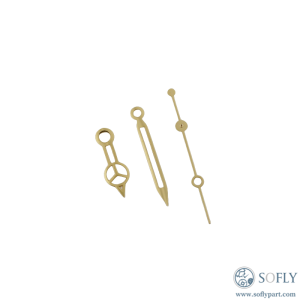
Watch hands may look small, but they shape almost everything about how a watch feels on the wrist. They affect how easily you read the time, how balanced the dial looks, and whether a watch feels sporty, elegant, vintage, or technical.
In this guide, you’ll learn what watch hands really are, why their design matters, how the most common hand styles differ from each other, and how to choose the right hands for your own watch—whether you’re buying, collecting, restoring, or modifying.
Watch hands are the moving indicators that show time on an analog watch. Most watches use three: the hour hand, the minute hand, and the second hand. These hands are driven by the movement inside the watch, which controls their speed and accuracy.
While their job is simple, their design is not. The very same movement can feel completely different depending on whether it’s paired with bold dive hands, sharp dress hands, or delicate vintage-style hands.
Watch hands affect far more than decoration. At a practical level, hand design directly controls legibility under different lighting and usage conditions. The right shape and contrast make the time easy to read in bright sunlight, low light, or while in motion.
At the same time, hand style defines the personality of a watch. It signals whether a watch is formal or sporty, classic or modern, elegant or rugged. For collectors and modders, watch hands are also one of the fastest ways to change a watch’s character without replacing the entire piece.
These twelve styles cover the vast majority of watches you’ll encounter in real life. Each one serves a clear visual and functional purpose.
Baton hands are the most common watch hands in modern watchmaking. Their straight, rectangular shape is clean, timeless, and easy to read. Because there are no curves or decorative details, they remain clear on almost any dial.
You’ll see baton hands on business watches, everyday automatics, and minimalist designs across all price levels. They work with both formal outfits and casual wear, which is why they never really go out of style. From a repair and modification standpoint, their standardized shapes also make them among the easiest hands to replace.
Dauphine hands are defined by their sharp, faceted surfaces. Each hand is split down the center, creating two angled planes that catch light differently as your wrist moves. This subtle reflection gives them a refined, high-end feel.
They appear most often on classic dress watches and luxury automatic models. If your watch is meant for formal settings or professional environments, Dauphine hands instantly raise its visual tone. Their visibility at night depends on whether lume is applied, but visually they remain one of the most elegant choices.
Sword hands are built for function above all else. Their wide profile and large luminous surface make them extremely easy to read in the dark, underwater, or in harsh outdoor conditions.
They dominate the world of dive watches, tactical watches, and rugged sports models. In the modification scene, sword hands are especially popular because they allow heavy lume application and instantly give a watch a stronger tool-watch personality.
Leaf hands, also called Feuille hands, have a soft, curved profile that resembles the shape of a leaf. Compared with the sharp lines of baton or sword hands, they look fluid and elegant.
They are most often found on vintage-inspired dress watches and traditional mechanical designs. Because of their slim structure, they are not made for heavy lume or extreme low-light use. For restorations and period-correct builds, however, they remain one of the most graceful options.
Breguet hands are recognized by their hollow circular tips, often described as “moon” shapes. This design comes from early European watchmaking and is deeply tied to classical horology.
You’ll mainly see them on high-end mechanical watches and heritage collections. At a glance, they communicate tradition, craftsmanship, and refinement. For collectors, Breguet hands are also an important detail in both authenticity checks and historical restorations.
Alpha hands sit between leaf and baton styles. They taper from a wider base to a pointed tip, creating a balanced and elegant silhouette.
They appear frequently on vintage reissues and mid-century inspired watches. If you want a watch that feels classic without being overly decorative, Alpha hands strike that balance well. From a modification perspective, they’re also versatile across casual and dress-oriented builds.
Pencil hands are long, slim, and sharply pointed, much like the tip of a pencil. Their design is simple, precise, and purposeful.
They are strongly associated with railway watches, field watches, and military timepieces. When lumed, their readability is excellent. They remain a favorite among enthusiasts who enjoy vintage military and tool-watch aesthetics.
Snowflake hands are defined by their large, block-shaped luminous sections. The design was created for one purpose: extreme visibility.
They are most often found on professional dive watches, where clear time reading in darkness is essential. Among modders, snowflake hands are highly sought after because of their strong lume performance and unmistakable tool-watch identity.
Mercedes hands feature a three-pointed cutout in the hour hand, creating one of the most recognizable shapes in modern watch design.
They are widely used on luxury sports watches and dive watches. The segmented lume helps the wearer instantly distinguish the hour hand from the minute hand in darkness. Because of their iconic status, they also have extremely strong demand in both collection and modification markets.
Skeleton hands are hollowed-out hands that allow you to see the dial or movement beneath them. They emphasize structure, lightness, and a modern mechanical look.
They are often used on skeleton watches and contemporary sports designs where visual complexity is part of the appeal. Their readability depends heavily on dial contrast, but for those who enjoy bold design and mechanical transparency, they remain very popular.
Plongeur hands are purpose-built for underwater use. They are short, bold, and heavily lumed to ensure instant visibility at depth.
You’ll find them almost exclusively on certified dive watches and professional diving instruments. Their design sacrifices elegance in favor of safety and clarity, making them one of the most functional tool-watch hand styles.
Lollipop second hands feature a luminous circular marker near the tip of the second hand. This allows the wearer to confirm at a glance that the watch is running, even in darkness.
They are commonly used on dive watches and military watches. Beyond their practical value, they also add a small but distinctive visual accent to the dial, which is why they’re popular in custom builds.
Dress watches tend to favor refined hands such as Baton, Dauphine, Alpha, Leaf, and Breguet. Diver and tool watches rely on Sword, Snowflake, Mercedes, Plongeur, and Lollipop hands for maximum visibility. Vintage watches usually feature Leaf, Alpha, and Pencil hands, while skeleton watches naturally pair with open-worked Skeleton hands.
Choosing watch hands is a balance between how you use your watch, how you want it to look, and whether the hands will actually fit your movement safely. A wrong choice doesn’t just look off—it can damage the dial or even stop the watch from running.
Office and daily wear favor clean, restrained styles like Baton, Dauphine, Alpha, and Leaf. Outdoor, sports, and water use demand high-visibility hand styles like Sword, Snowflake, Mercedes, Plongeur, and Lollipop. Vintage projects usually look best with period-correct shapes such as Leaf, Pencil, or Alpha hands.
Most hands are made from stainless steel, brass, or aluminum. Polished finishes feel dressier, brushed finishes reduce glare for tool watches, and heat-blued or gold-plated hands add a classic touch. Modern lume such as Super-LumiNova is essential if night visibility matters.
Watch hands are not universal. Hole diameter, hand length, and stack height must match the movement exactly. Incorrect sizing leads to bent hands, scratched dials, misalignment, or hands stopping completely. If any measurement is uncertain, professional installation is always safer than trial and error.
The golden rule:
Lifestyle decides function. Finish defines character. Compatibility determines whether the upgrade is safe.
Over time, watch hands are exposed to constant motion, vibration, and occasional impact. As a result, they may loosen, lose their luminous performance, suffer from minor misalignment, or even bend due to shock. These gradual issues don’t just affect how the watch looks—they can also interfere with accurate timekeeping if left uncorrected.
In many cases, these problems aren’t signs of serious movement failure. Instead, they are natural wear-and-tear issues that build up through daily use. This is also the point where many owners begin to consider replacing or upgrading their watch hands.
It’s normal for lume to fade, tastes to change, and accidental damage to happen—it’s simply part of owning and wearing a watch. Replacing the hands is one of the most effective ways to restore clarity, improve visibility, or completely transform a watch’s personality, whether you’re refreshing a daily wearer or restoring a vintage piece.
With the right tools and experience, DIY replacement is possible. However, professional installation greatly reduces the risk of bent hands, scratched dials, or movement damage. For enthusiasts who want both variety and precision, platforms like Soflypart offer a wide range of ready-made watch hands as well as watch hand tools, making it easier to match hand styles, finishes, and lume precisely to specific movements and watch dial designs.
Whether you choose to handle the upgrade yourself or work with a professional, proper fitting and compatibility always matter more than speed.

1. What are the most common types of watch hands?
Baton, Dauphine, Sword, Leaf, Breguet, Alpha, Pencil, Snowflake, Mercedes, Skeleton, Plongeur, and Lollipop.
2. Which hands are the easiest to read?
Sword, Snowflake, Mercedes, and Plongeur hands offer the highest legibility.
3. Can watch hands be replaced on any watch?
Most mechanical and quartz watches allow hand replacement, but compatibility depends on the movement.
4. Are watch hands universal?
No. Sizes and hole dimensions vary by movement.
Watch hands may be small, but they define how a watch communicates time, character, and purpose. The right hands improve readability, strengthen design identity, and often completely change how a watch feels on the wrist. Whether you’re choosing a new watch, restoring a vintage piece, or building a custom project, understanding watch hand styles gives you real control over both function and aesthetics.