
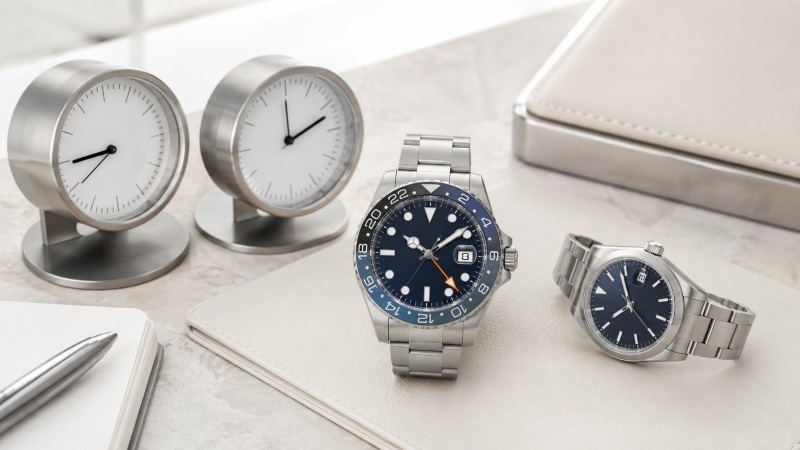
Comparing NH34 vs NH35 starts with what you want the finished watch to display. The NH34 adds a central GMT hand and date, the NH35 uses a three-hand date layout, and the NH36 combines three hands with day and date.
All three belong to the TMI NH3 series and share similar core performance characteristics. Your choice changes the dial, hands, calendar layout, and space required above the dial. This guide begins with their shared specifications, then explains how GMT operation, component fit, and day-date design shape the finished watch. By the end, you will know which movement supports the build you have in mind.
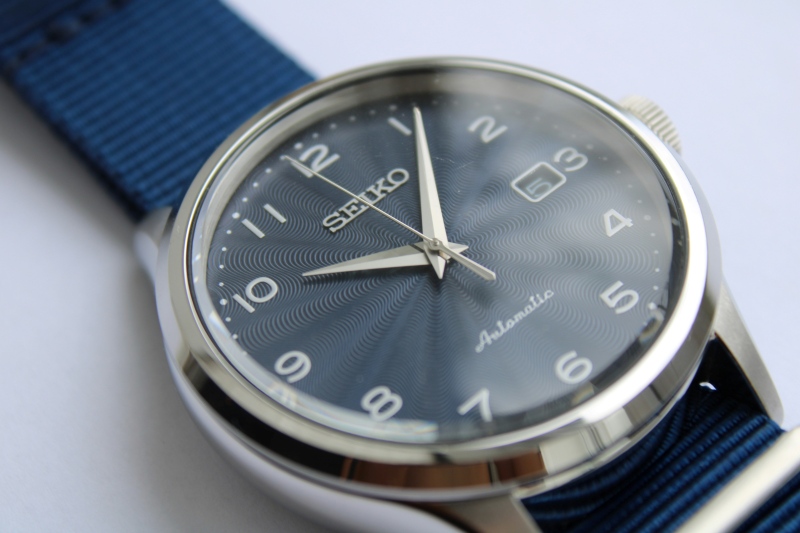
The NH34 and NH35 share the same core dimensions and timekeeping specifications. The main difference is what they display: the NH34 adds an independently adjustable 24-hour GMT hand, while the NH35 uses a conventional three-hand layout with a date.
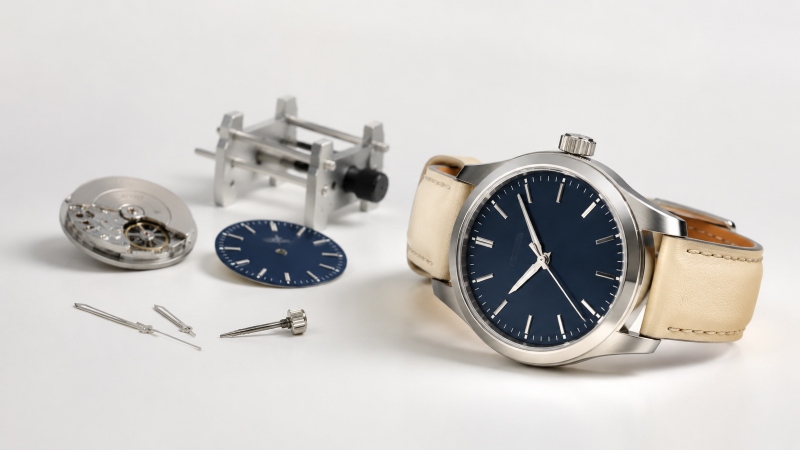
Both calibers belong to TMI’s NH3 series. The current NH3 Series Technical Guide lists the following specifications:
Specification | NH34A | NH35A |
Main display | Time, GMT, date | Time, date |
Central hands | Four | Three |
Outside diameter | 27.40 mm | 27.40 mm |
Casing diameter with spacer | 29.36 mm | 29.36 mm |
Official movement height | 5.32 mm | 5.32 mm |
Jewels | 24 | 24 |
Frequency | 21,600 vph | 21,600 vph |
Running time | More than 41 hours | More than 41 hours |
Static accuracy | -20 to +40 seconds per day | -20 to +40 seconds per day |
Winding | Automatic and manual | Automatic and manual |
Stop-second device | Yes | Yes |
The GMT function does not give the NH34 a faster frequency, longer running time, or tighter factory accuracy range. It gives the watch another layer of time information through a fourth central hand.
The NH35 keeps the same underlying performance in a simpler three-hand date format. The practical choice is therefore about how you want to read and use the finished watch, rather than choosing between two different performance grades.
In daily use, the Seiko NH34 lets you keep the main hands on one time zone while adjusting its 24-hour hand to another. The Seiko NH35 uses the same first crown position only for date correction, making it more straightforward when a second time zone would add no useful information.
At the first crown click, turning the crown in one direction adjusts the NH34’s 24-hour hand independently. Turning it in the other direction changes the date. Because the main hands continue running during these adjustments, you can update the second time zone without resetting the primary time display.
Pulling the crown to the second click stops the seconds hand and lets you set the main hour and minute hands. TMI also advises against changing the date between 9:00 p.m. and 4:00 a.m., when the calendar mechanism may already be engaged.
This operating pattern is commonly called a caller or office GMT. For example, you could keep the main hands on Chicago time and set the GMT hand to Tokyo. The 24-hour scale then helps you distinguish morning from evening in the second zone.
A traveler GMT works differently: it allows the local 12-hour hand to jump independently after arrival. On the NH34, the independently adjustable hand is the 24-hour GMT hand, so it is better suited to monitoring a remote time zone than repeatedly changing local time during a trip.
If that operating pattern supports the watch you want to build, Soflypart’s SEIKO (SII) NH34 Mechanical Movement is the corresponding GMT option.
The NH35 removes the GMT setting step. Its first crown click adjusts the date, while the second position sets the hour and minute hands and stops the seconds hand. There is no fourth hand or separate 24-hour scale to read and align.
That simpler interaction works well for a watch you want to wind, set, and wear without tracking another location. It also leaves the dial focused on the primary time and date.
For a conventional three-hand date project, Soflypart lists the SEIKO (SII) NH35 Mechanical Movement.
Both calibers support manual winding and stop-second time setting. The daily-use decision is therefore whether the additional time zone will serve a real purpose in the finished watch. If it will, the NH34 earns the extra hand and setting step. If it will not, the NH35 keeps the experience clearer.
Matching movement dimensions do not make the NH34 and NH35 automatically interchangeable. The case, crystal, dial, hands, movement holder, stem, and crown must work as one assembly. The NH34 adds further requirements because its GMT display needs a fourth hand and additional space above the dial.
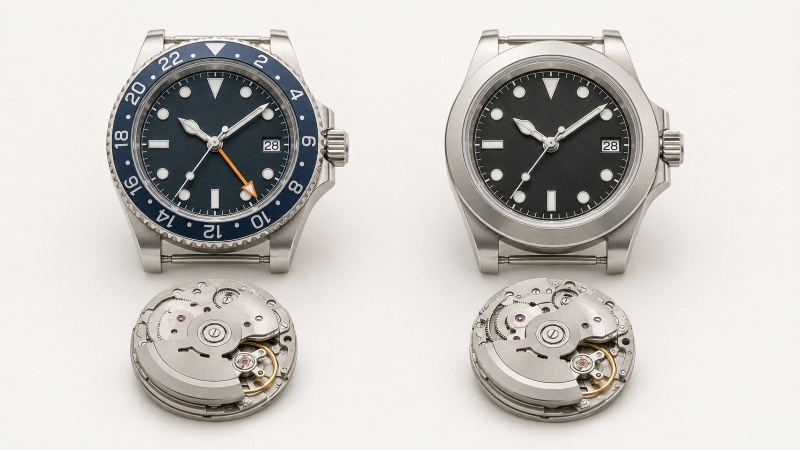
TMI lists both movement bodies at 27.40 mm in outside diameter and 5.32 mm in height. Their casing diameter with the dial-holding spacer is 29.36 mm.
These measurements help define the movement cavity, but the 5.32 mm figure does not represent the complete installed hand stack. The NH34 carries four central hands, so its uppermost hand sits higher above the dial than the three-hand stack of the NH35.
Do not assume that a case advertised only for the NH35 will accept an NH34. Confirm that the case or crystal specification supports the NH34 hand stack, especially when the design uses a flat crystal or leaves little clearance above the hands.
The movement holder matters as well. It must position the caliber at the intended height while keeping the winding stem aligned with the crown tube. A holder that seats the movement too high or too low can affect both hand clearance and crown operation.
An NH34 build needs a dial whose center opening clears the GMT post and fourth-hand fitting. A dial designed only for the NH35 may have the correct outer diameter while still lacking enough clearance at the center. Using a dial specified for the NH34 avoids treating outer diameter as proof of compatibility.
The finished watch also needs a readable 24-hour reference. This scale can appear on the dial, chapter ring, or bezel. Without it, the GMT hand continues to rotate, but the wearer cannot read the second zone precisely.
Check the date aperture, dial feet, and crown orientation at the same time. A compatible outer diameter does not confirm that the calendar will sit correctly in the window or that the dial will mount in the required orientation.
The NH34 requires a four-hand set with a dedicated GMT hand. Confirm the fitting sizes as well as the length and shape of each hand; a handset described only as “NH compatible” does not necessarily include the correct GMT component.
During installation, all four hands must sit level, clear one another throughout a full rotation, and remain below the crystal. The additional layer makes hand alignment and final clearance checks especially important.
The winding stem must first match the movement, then be cut to suit the assembled case and crown. Soflypart’s watch stems collection provides available options, but the final stem length can only be established after the movement, holder, case, and crown are brought together.
Before ordering parts for an NH34 vs NH35 build, confirm these five interfaces:
Compatibility comes from these interfaces working together. Sharing the NH3 family and the same published body dimensions is only the starting point.
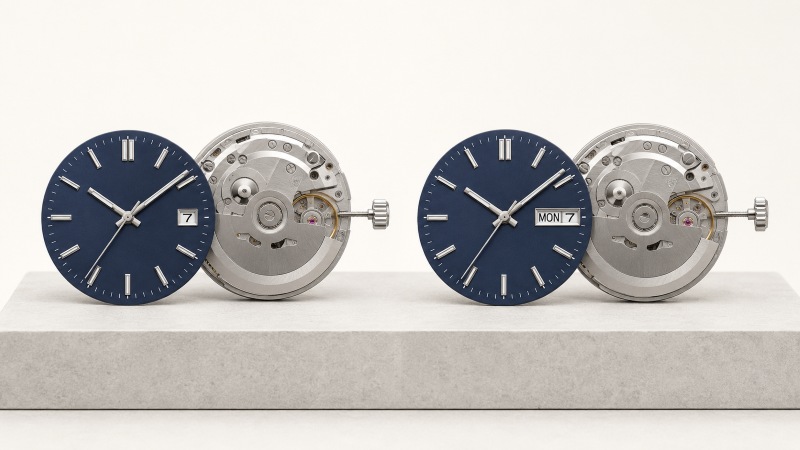
The day wheel is the main functional difference between the NH35 and NH36, but it changes more than the movement’s parts list. It also determines the required dial windows, calendar layout, and first-click crown operation.
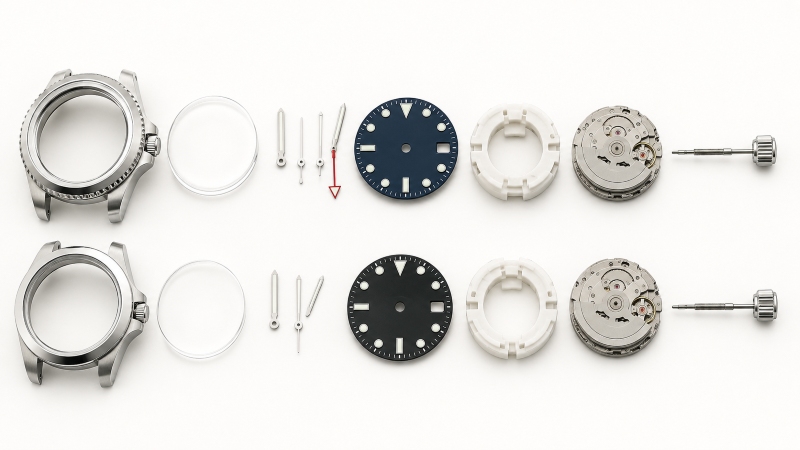
The Seiko NH35 displays the date, while the Seiko NH36 displays both the day of the week and the date. TMI gives them the same core dimensions, frequency, jewel count, running time, static accuracy range, manual winding, and stop-second function. The NH36 adds calendar information rather than a higher level of timekeeping performance.
At the first crown click, the NH35 adjusts the date in one direction, with no second calendar function in the other direction. On the NH36, one direction adjusts the date and the other adjusts the day. Pulling the crown to the second click sets the main time and stops the seconds hand on both calibers.
This makes the NH35 vs NH36 decision primarily about the display you want to use. A date-only design points to the NH35. A design that gives the weekday a visible role points to the NH36.
An NH35 dial normally needs one aperture for the date. An NH36 dial needs correctly positioned openings for both the day and date. The dial feet, calendar windows, and crown orientation must all match the selected movement variation.
Check the exact day disc before ordering an NH36. TMI’s current NH36 references include an English/Spanish day disc with a white background, black weekday lettering, a blue Saturday, and a red Sunday. Do not assume that every available NH36 uses the same language or color configuration without checking its complete reference.
A date-only dial may hide the NH36 day wheel, but that does not confirm that its feet, date aperture, or orientation are compatible. It would also leave the movement’s defining feature unused. If the finished watch should display only the date, the NH35 is the more direct match.
If both calendar functions belong in the design, confirm the day-disc language, crown position, and two-window alignment before selecting the SEIKO (SII) NH36 Mechanical Movement.
Choose the movement from the watch you are trying to build, not from a small difference in the specification table. First decide what must appear on the dial, then check whether the parts already selected can support that display.
Your Starting Point | Best-Fit Movement | Confirm Before Committing |
A second time zone is essential to the watch’s purpose | GMT-ready dial, four-hand set, 24-hour scale, and sufficient crystal clearance | |
You want a straightforward automatic watch with a date | Date-window position, dial feet, holder, and stem alignment | |
The weekday is an intentional part of the dial design | Day-disc language, day-date windows, and crown orientation | |
You are replacing an existing movement | Match the exact caliber and variation already installed | Movement marking, crown position, calendar layout, hand height, and stem |
If you are beginning with a blank design, choose the movement first and build the dial, hands, and case around it. This is especially important for an NH34 project because the GMT hand and the space above it must be planned from the beginning.
If the case or dial has already been selected, work in the opposite direction. Identify the display layout and all physical interfaces before choosing the caliber. A date-only dial naturally narrows the build toward the NH35, while an existing day-date dial must match the exact NH36 calendar arrangement.
For a replacement rather than a new build, start with the caliber code on the removed movement. Choosing only by diameter or by the functions visible through the dial can miss differences in the calendar, hand height, stem, or crown position.
Before ordering, confirm the following as one configuration:
Once those points are confirmed, browse Soflypart’s Seiko watch movements to find the movement that matches the completed plan.



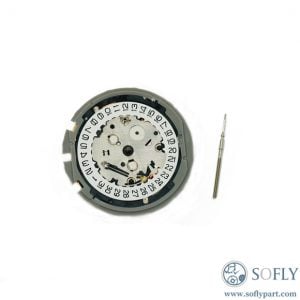
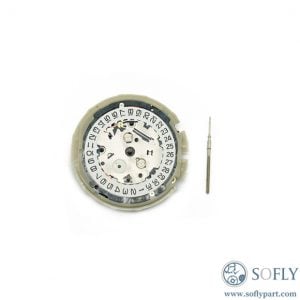

The NH34 vs NH35 choice comes down to whether a second time zone has a real role in your watch. Choose the NH34 when you need GMT and have a compatible case, dial, and handset. Choose the NH35 when you want a cleaner three-hand date display with fewer build requirements. If the weekday belongs in your dial design, the NH36 is the more natural fit.
Choose the function you will genuinely use, then let that decision guide the components around it. When the movement and the rest of the watch are planned as one system, the finished build feels intentional instead of shaped by avoidable compromises.
Once your display and compatibility requirements are clear, explore Soflypart’s Seiko watch movements and choose the caliber that brings your build together.
No. TMI lists both movements at 5.32 mm, although the NH34’s fourth hand requires more clearance above the dial.
Only if the case also supports the NH34 hand stack, dial, holder, and stem alignment. An NH35 case label or matching movement diameter alone does not confirm compatibility.
Not as automatic drop-in replacements. Their body dimensions are similar, but the dial and calendar layout must match the selected movement.
They are TMI NH3-series supply movements and are commonly marketed as Seiko or TMI movements. Use the exact NH caliber code when selecting replacements or parts rather than assuming that a similarly numbered 4R caliber is identical.